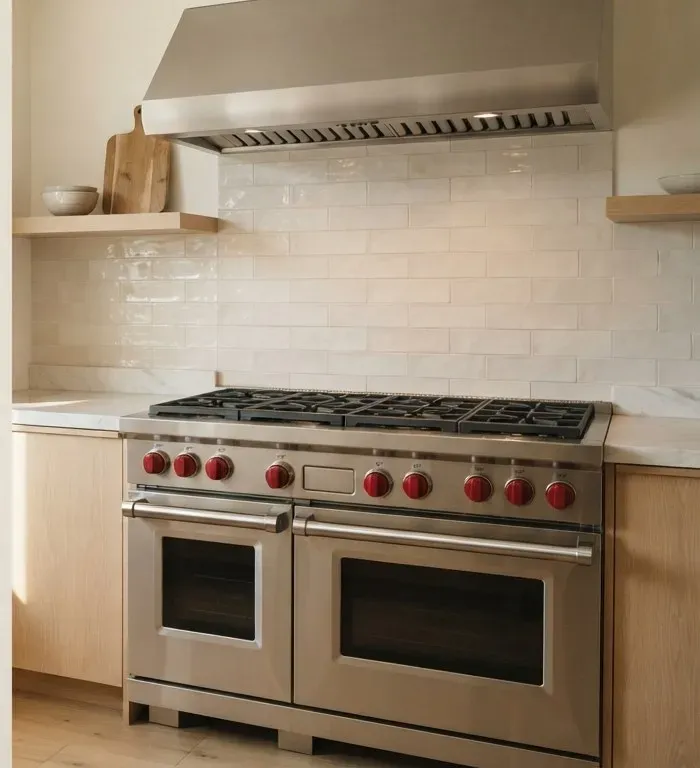
San Jose Appliance Care handles Wolf range and oven repair calls in San Jose. The letters at the front of a Wolf model number say what you own: DF for a dual fuel range, GR for a gas range, IR for an induction range, SRT for a sealed burner rangetop, CG and CI for gas and induction cooktops, SO and DO for single and double wall ovens in the M, E and L Series, CSO for a convection steam oven, WWD for a warming drawer and MD for a microwave drawer. An igniter or a door latch is a small part, but on a Wolf it’s inside a heavy range set into the counter line or a wall oven fitted into cabinetry. So the call starts with which Wolf you own and the symptom. On a wall oven, the series badge counts too, since Wolf publishes its codes and fixes per series. Wolf owners in Los Gatos, Sunnyvale and nearby cities use the same number.
Igniter still ticking after the burner lights
Wolf’s list for ticking that won’t quit is short. Moisture is first: a burner that got wet in cleaning or a boil-over keeps sparking until it dries out. After that comes a dirty or crooked burner cap that breaks up the flame, or a pot so wide it chokes the burner’s air, which lifts the flame and keeps the igniter firing. Past those, Wolf points to a bad spark module or burner switch, a worn electrode or igniter, or polarity reversed at the outlet, and each of those is a repair.
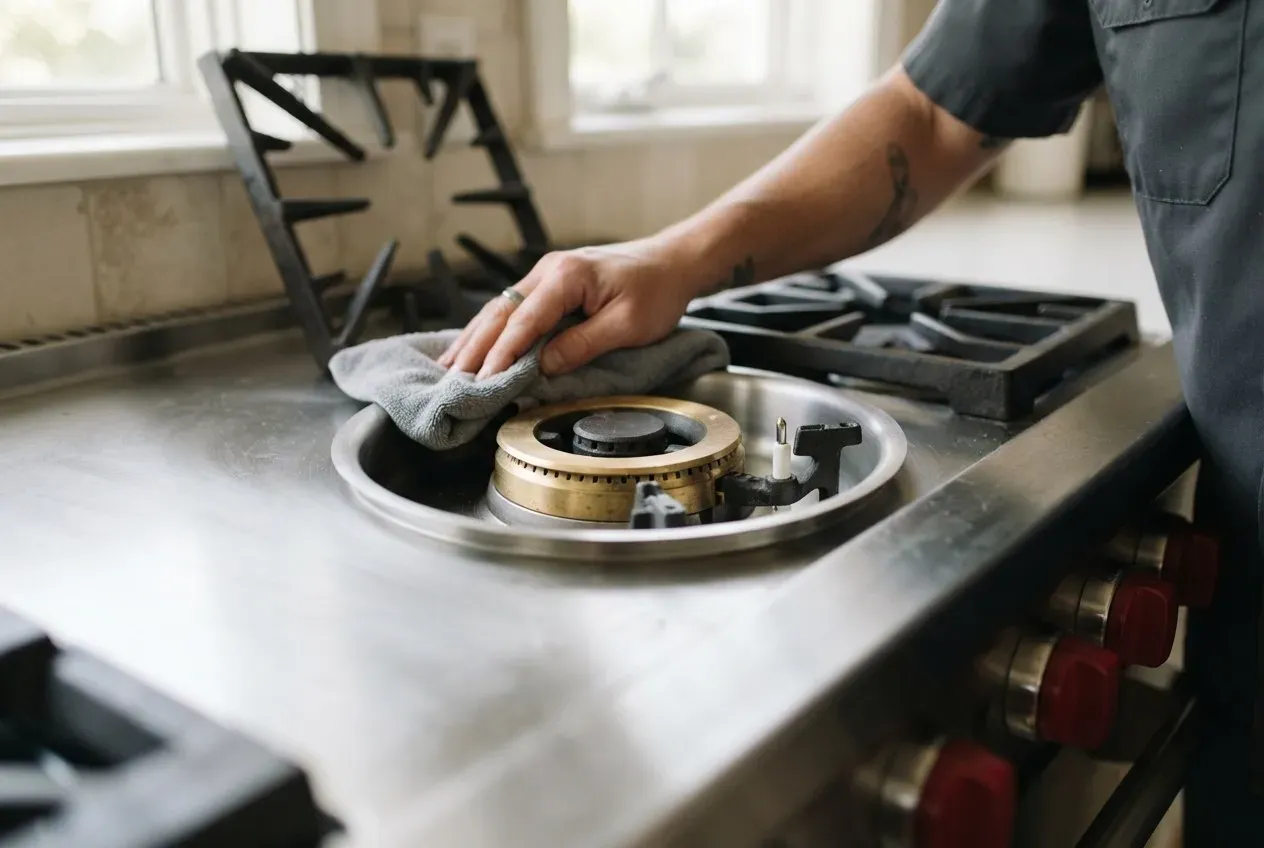
On the call, say whether the ticking began after a spill or a cleaning, whether it’s one burner or all of them, and whether it ticks with every knob off. If a burner sparks with its knob off, don’t use it until the tech has seen it.
A burner with no spark at all
Every Wolf igniter is electric, so total silence points to power first. On a new install, Wolf also wants the range set up for the gas it’s actually running on. Once power and the gas setup check out and there’s still no spark, Wolf looks to the burner switch, the spark module and the igniter.
Cooking through a power shutoff in the hills
Hillside homes above Los Gatos sit in a Very High Fire Hazard area, and PG&E shuts the power off there in fire weather. A Wolf range loses its spark when that happens, but Wolf says the surface burners can still be lit by hand: knob to high, a multi-purpose lighter at the burner ring, one burner at a time. With no power there’s no automatic relight, so stay with the pan. The SRT wok burner can’t be lit by hand, and neither can a gas oven, whose igniter needs electricity. Wolf wants the oven turned off for the whole outage. If the igniters don’t spark once the power is back, call us.
Wolf wall oven codes: F1, 2720 and E123
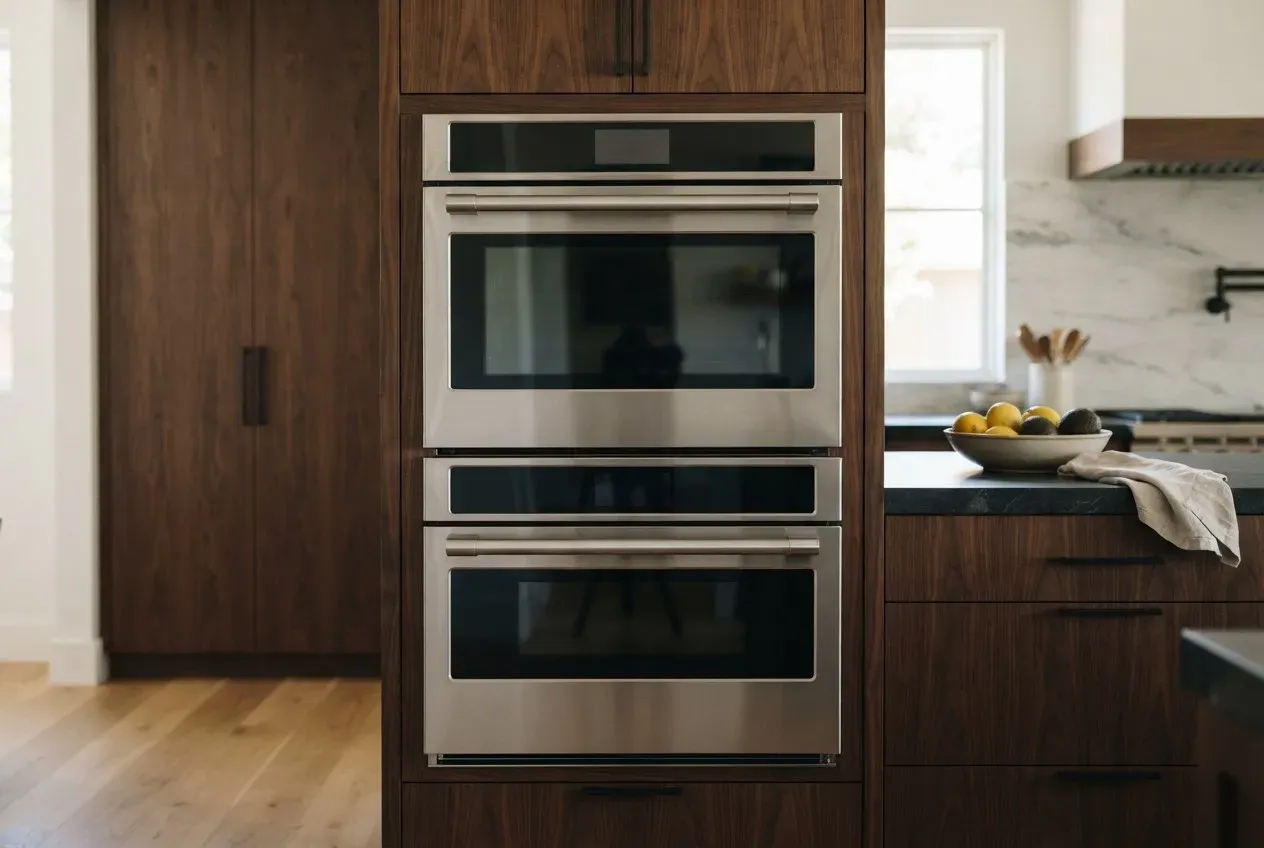
Read the badge before the code. You can also tell the series apart at a glance. An M Series oven pairs an LCD touchscreen with three halogen lights, while an E Series has two lights and a full-color touchscreen. L Series ovens keep a code list of their own.
| Oven | Code | Wolf’s meaning |
|---|---|---|
| L Series wall oven | F1 | While the lock motor ran, the control didn’t sense the lock switches within 60 seconds; a door slammed in a heating mode can set it off |
| M Series wall oven | 2720 | Watchdog fault tied to an element or the motorized latch |
| Touch-control convection steam oven | E123, or F5 as a message | No owner-facing cause published |
For each of these, Wolf’s advice on a code that keeps coming back is a service visit. Give us the series and the code exactly as the display shows it. Codes from other makers are in the appliance error code library.
Self-clean finished, oven cold or latched shut
When a Wolf oven won’t heat right after self-clean, Wolf gives two reasons: the power cut out mid-cycle, or the heat tripped the thermal cutout. If the fans spin and the oven still won’t heat, Wolf treats it as a service call.
The door is supposed to stay locked while the oven cools from self-clean. Once it’s cold, a lock that won’t release points to one of four parts on Wolf’s list: the control board, the relay board, the motorized latch or the wiring between them. With a double oven, tell us which cavity is stuck. Problems Wolf shares with other brands are covered under oven, range and stove repair.
Wolf oven not heating or not holding temperature
Start with what the oven was asked to do. Wolf’s own checks are that the right mode is on and the oven isn’t in Showroom mode, and on a double oven, whether the other cavity heats. When the set temperature won’t change at all, Sabbath mode is usually on. Past those, Wolf lists a tripped thermal cutout, a cooling fan fault, a control or relay board error and a bake element as the causes, and that’s the order the tech tests them.
Convection fan not running
On L, E and M Series electric ovens, the convection fan only runs in a convection mode once preheat is done, so a quiet fan in Bake is normal. On GR gas ranges the fan has its own switch above the door, and it won’t run with the door open or in broil. Wolf also warns that switching convection on during preheat can shut the oven off. A cooling fan that keeps running long after the oven is off is normal too. If the convection fan doesn’t turn in a convection mode after preheat, it’s a repair.
Wolf parts covered in years three to five
Wolf’s five-year parts-only list, in the coverage table further down, is where electronics land. A control board that fails on a four-year-old wall oven falls inside it, and so does a dead induction generator. Igniters and spark modules fall under the shorter terms, and hood recirculating filters sit outside the warranty. If you’re inside one of these periods, say so on the call.
Out of warranty, the cost depends on the part and on how long it takes to get at it when the range or oven is fitted into cabinets. You only pay for work you agreed to. The appliance repair cost guide explains what moves the figure. A Sub-Zero in the same kitchen has its own terms, set out on the Sub-Zero repair page.
Induction zone stays off with a pan on it
A Wolf induction zone won’t switch on until it senses cookware, so the pan must be magnetic. Lock mode keeps the zones dark as well, and Showroom Mode does the same, reading SHR, 5HR or SHOW on the display. With a magnetic pan, neither mode on and the zone still cold, it’s a job for the tech.
Wolf’s induction codes are listed by model line. On CI cooktops, Error 3 usually means water or a pan is sitting on the glass over the controls, and Error 47 needs service. On CT cooktops, E13 points to the OFF key, and F7 means the electronics passed 158°F, so Wolf’s first checks are the installation and the ventilation around the cooktop. On IR30450 and IR36550 induction ranges, E07 says a component is running too hot. Read us the code and the model line. Gas and induction cooktops from every brand are covered under cooktop and microwave repair.
Descale message or fill trouble on a steam oven
A Wolf convection steam oven reports scale in its boiler with the message “Boiler scaled up, please descale.” Wolf’s current instructions say to descale once a year whether that message shows or not. Frequent refill prompts and unusually high water use are other signs of scale. Wolf warns that vinegar may damage the oven, so if someone has run vinegar through it, mention that.
What goes in the tank matters for another reason. Wolf rules out reverse osmosis, distilled and demineralized water for the tank, since the sensor that reads the water level needs minerals in it to work. If you’ve been filling it from an RO tap and the fill or water readings act strangely, tell us. On CSO2450 and CSO3050 models, the water hardness setting is under Settings, and it helps to read us what it’s set to.
Burner flame turning yellow
A Wolf burner on natural gas should show an all-blue flame around a darker blue inner cone, with no yellow in it. On LP, orange tips are normal, as is a taller flame the first time a burner lights each day. Construction dust or a running humidifier can also turn the flames yellow, Wolf says, so mention any recent remodel. Wolf ranges come with their own regulator, and Wolf lists an extra external regulator as one cause of a poor flame.
Wolf range recalls, and a gas smell
A gas smell at the range comes before everything else on this page. Follow the steps at the top of our oven and range repair page first, then call.
Wolf has recalled some dual fuel ranges with an infrared griddle, 36, 48 or 60 inches wide and sold from August 2020 through September 2024. On those, a boil-over or spill could short the range and turn the griddle on by itself, so the range shouldn’t be used until it’s repaired. An older recall covered 48-inch double-oven gas ranges (models P48, PS48 and R48) sold from 1998 to 2008, over delayed ignition in the smaller 18-inch oven. On those, the 18-inch oven stays off until it’s fixed, while the large oven and the burners are unaffected. Keep the model and serial number nearby for the call.