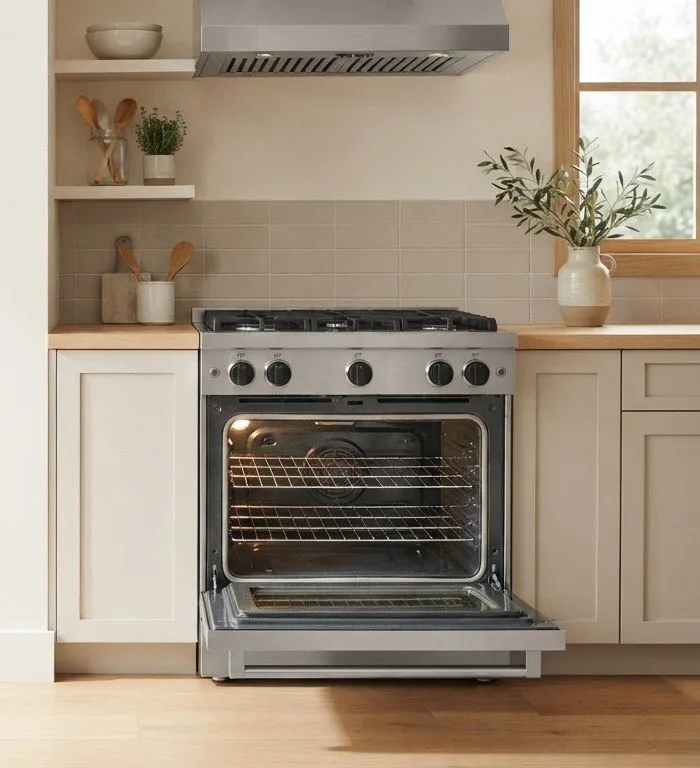
San Jose Appliance Care books oven, range and stove repair across San Jose for gas, electric and dual-fuel cooking appliances. That covers freestanding and slide-in ranges, single and double wall ovens, oven and microwave combination wall units, and pro-style ranges with their own brand-specific parts. A registered, insured appliance tech starts with the parts behind most oven trouble: the bake igniter and gas valve on a gas range, the bake and broil elements on an electric one, and the temperature sensor and control board on either type.
Smell gas in the kitchen?
- Get everyone out of the house right away.
- Don’t touch light switches or pull any plugs as you leave.
- Call 911 once you’re outside.
When the house is safe and the gas is off, call us about the range.
Burners light, gas oven stays cold
If the cooktop lights and the oven won’t, the fault is on the oven side. The tech works through it in a set order. The pressure regulator at the back comes first. GE notes its lever can spring to OFF when a range is installed or moved, and in that position the top burners still get gas while the oven gets none. Say so on the call if the range was recently installed or slid out for cleaning.
The igniter is next. On most gas ovens a glow-bar igniter near the back of the oven floor lights the bake burner. Per GE, an igniter that never glows points at the igniter itself, the oven control or other electrical parts. One that glows without lighting the burner sends the tech to the igniter and gas valve together, so it helps to know which you’ve seen.
Leave the oven off until it’s checked if the burner lights with a boom or the door pushes open as the gas catches. GE calls both delayed ignition, and both need service.
Only the broiler heats on an electric oven
Electric ovens bake with an element across the cavity floor and broil with one across the top. When broil works and bake doesn’t, the bake element is the first part tested. A burned-out element often looks the part, with a crack, a break or a blistered spot on its metal sheath.
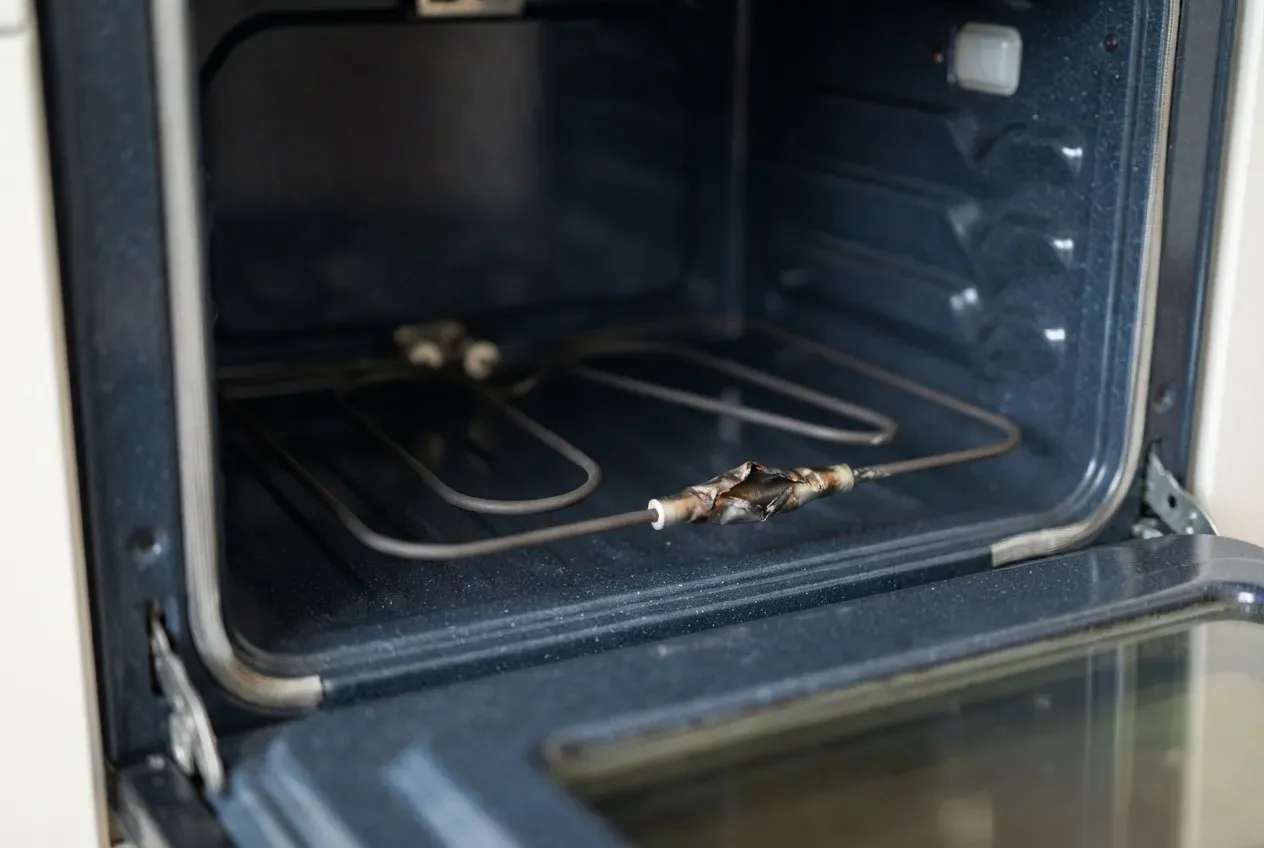
Some elements fail with a show. GE describes an element shorting against its own sheath, which can split it open and spit sparks for a few seconds or trip the breaker. The sparks die out by themselves, but GE says not to run the oven again until the element is replaced. Mention sparks or a tripped breaker when you call, since the tech then checks the wiring and control along with the element.
Oven temperature wrong: running hot or cold
Some swing is normal. GE says an oven runs roughly 30 degrees over and under the setting as it cycles on and off, so one thermometer reading doesn’t prove anything. The signs of a real fault are results that changed overnight, an oven that overshoots badly every time, or a display that flags the sensor.
Give us a rough idea of how far off it seems and when it started. The tech checks the temperature sensor with a meter against that model’s spec, then confirms the control is reading it right. Older ranges with dial knobs use a mechanical thermostat, and it gets tested in the same way.
Dead display, a blank clock or an error code
A blank display that ignores the touch pads usually traces back to the power supply to the range or to the control board. GE’s first step for a control acting up is to switch the range off at the breaker for one minute and back on. When the display shows a code instead, write it down along with the model number. Each brand uses its own codes, and the oven and appliance error code library collects the ones manufacturers publish.
Self-clean problems: door locked, or the oven dead afterward
After a self-clean cycle the door lock is meant to stay engaged until the oven cools, and GE’s first step for a stuck door is to wait out that cool-down. If the oven is cool to the touch and the door still won’t release, the lock assembly or the control that drives it is the next thing on the list.
Self-clean is the hottest job an oven does. An oven that won’t heat or shows nothing at all right after a cleaning cycle has often lost a part to that heat: a thermal cutoff that opened, a lock that didn’t release its switch, or a control board. Say on the call that it happened after self-clean, because it sends the tech straight to those parts.
Oven won’t turn off
Cancel any cycle or timer from the control first. If the oven keeps heating, GE’s advice is to switch off the breaker that feeds the range or wall oven, and leave it off. An oven that heats with the control off has a stuck relay, a failed control board or, on older ranges, a thermostat that has stuck closed. It isn’t safe to keep using until the tech has found which.
Convection fan not working
Some stops are normal. GE says the convection fan cycles on and off during a convection cycle, shuts off when the door opens, and on gas models doesn’t start until the oven has preheated. A fan that never turns, grinds or squeals on a convection setting has a failed fan motor or a control that isn’t sending it power. Ovens with true convection also have a heating element behind the fan, and it gets tested along with the motor.
Pilot won’t stay lit on an older gas range
Older ranges with standing pilots keep a small flame burning all the time. When the pilot lights and goes out again as soon as you let go, the thermocouple or the safety valve it controls is usually at fault, and that’s gas work for the tech, not a reason to keep relighting it.
Oven light out
The light runs off a bulb and a switch, often the door switch that also tells the control the door is shut. A bulb that still won’t light once it’s been replaced points at the switch, the socket or the control. Mention it on the call if another fault is on the list, and it gets checked on the same visit.
One coil burner on the range top stays cold
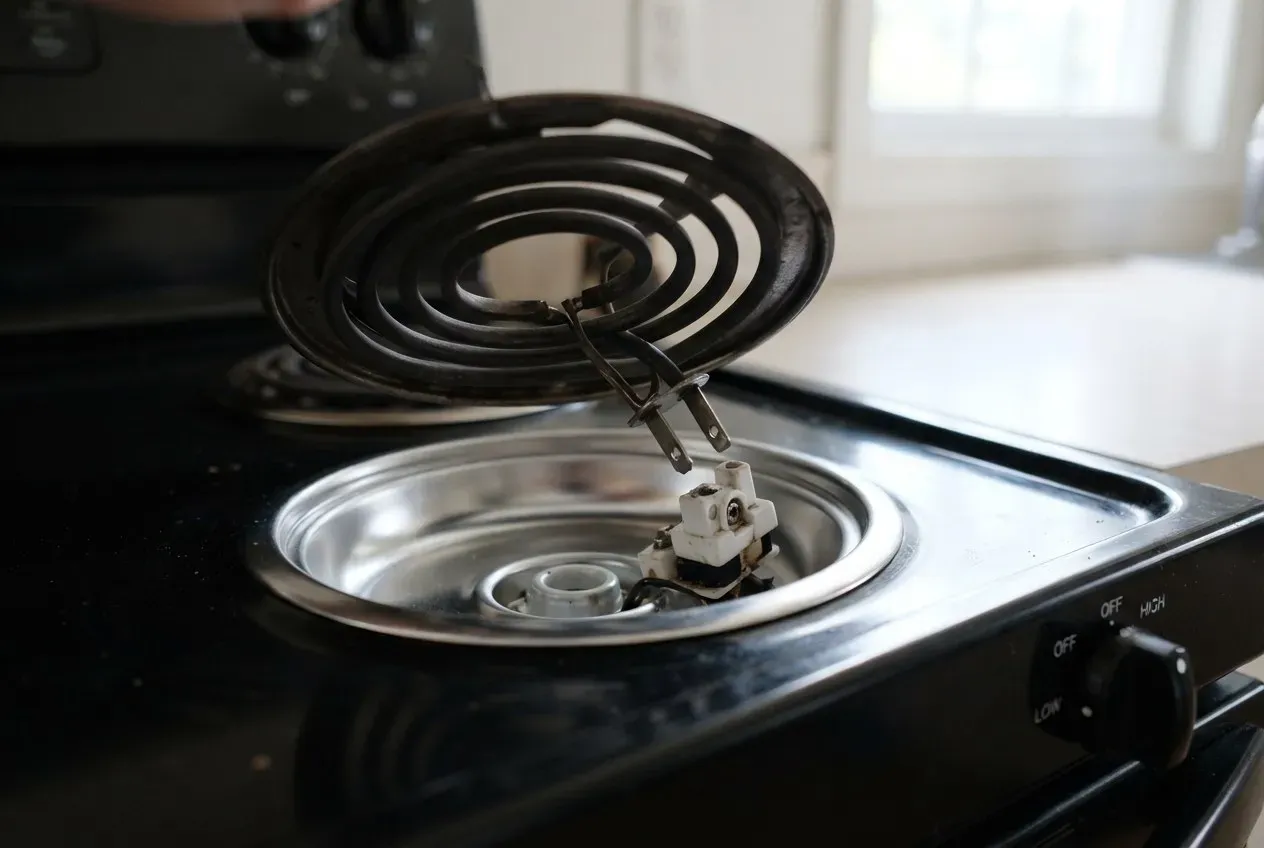
Coil elements are the simplest stove-top repair. The tech swaps the dead coil into a working socket of the same size. GE’s rule is that a coil that stays cold in the good socket needs replacing, while one that heats there means the original socket or its switch has failed.
Clicking gas burners, cracked glass tops and induction zones that won’t come on are a separate set of parts. Our cooktop and microwave repair page goes through them, and one visit handles the cooktop too when it’s part of the range.
The anti-tip bracket behind a freestanding range
A freestanding range can tip forward when a child climbs on the open door or someone sets a heavy pot on it. The U.S. Consumer Product Safety Commission estimated an average of 1,700 emergency-room injuries a year from appliance instability and tipovers in 2006 through 2008. It also received reports of 13 deaths linked to stove, oven and range tipovers from 2000 through 2008, many involving children under 10.
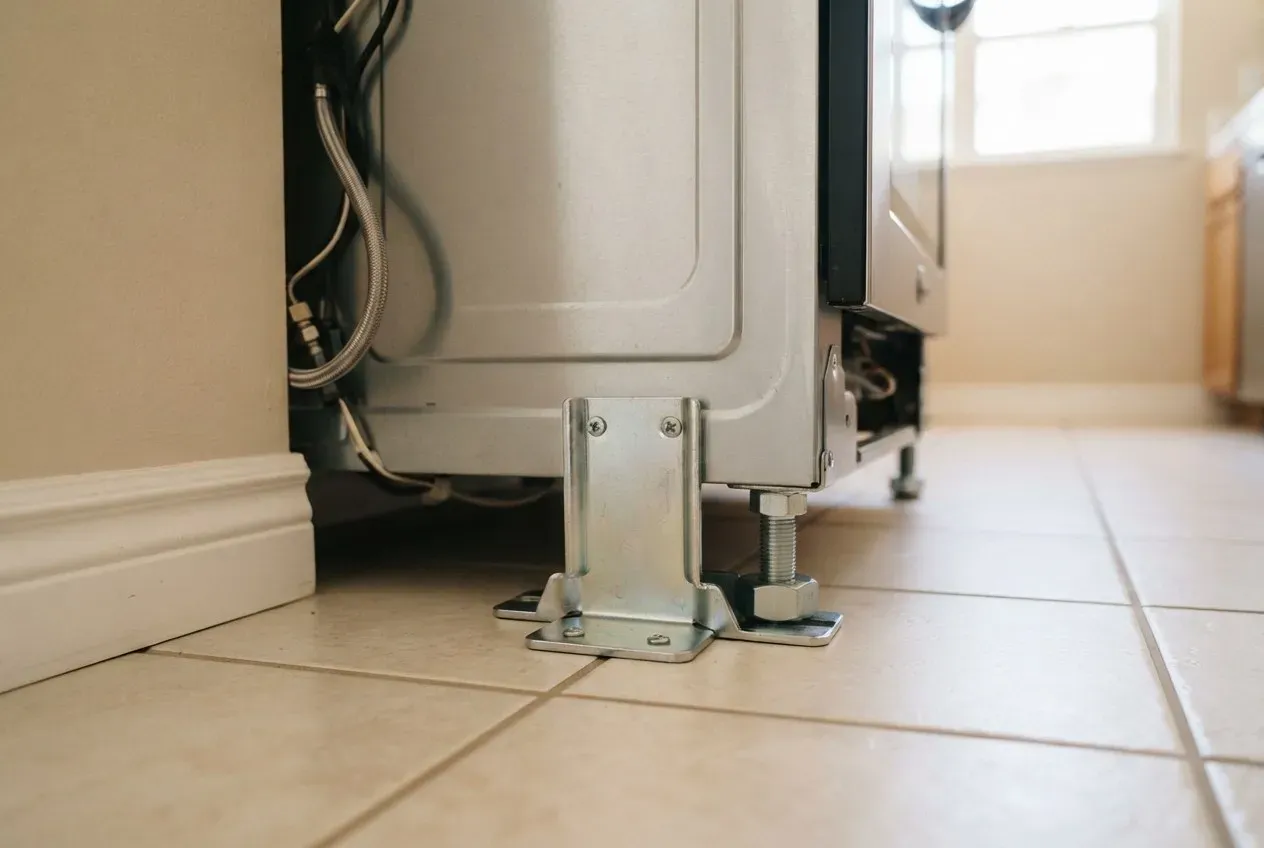
Under voluntary safety standards, every new range comes with an anti-tip bracket that fastens to the wall or floor, and the range has to sit locked into it. A repair that pulls the range out is a good time to check. Ask the tech to confirm the foot is caught in the bracket before the range slides back.
Igniter, element or control board: what drives the price
The failed part decides most of the cost. An igniter, element or sensor is a modest job on most ranges. A control board or gas valve costs more, and gas work takes longer because it has to be tested safely. Access counts as well. Some wall oven repairs mean taking the oven out of its cabinet, and pro-style ranges from Wolf, Thermador, Viking, BlueStar, Dacor, Bertazzoni and Monogram use pricier parts that sometimes have to be ordered.
Nothing gets replaced until you’ve approved a written price, and you only pay for work you agreed to.
When one part fails on a range that’s otherwise in good shape, repair is the usual call. Replacement starts to look better when the control board fails along with another major part, or when parts for the model have been discontinued. The repair or replace guide walks through that choice, and the appliance repair cost guide lays out typical prices by appliance.
Oven and range repair beyond San Jose
Range and wall oven calls come from all over San Jose and from neighboring Santa Clara, Cupertino and Los Gatos. When you call, give the brand, say whether it’s gas, electric or dual-fuel, and describe what happens when you turn it on.