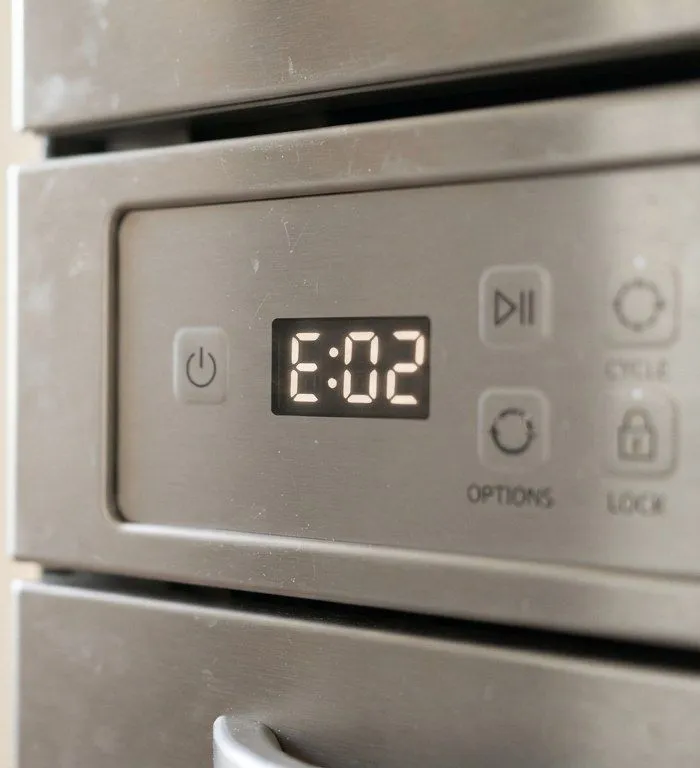
The letters and numbers on an appliance display are the control board’s way of saying a part or condition didn’t check out. San Jose Appliance Care pulled every code below from manufacturer support material for Samsung, LG, Whirlpool, GE, Bosch, Thermador, Frigidaire, Sub-Zero and Wolf. Each table covers one brand and appliance type, from washers and dryers to refrigerators, dishwashers and ovens, and gives the meaning plus where the tech starts. Read the code out when you call from San Jose or a neighboring city, and the likely part is narrowed down before a registered tech takes a panel off.
The families most codes fall into
Brands spell their codes differently, but nearly every code points at one of a few systems. Knowing the family tells you how urgent it is.
- Water in and out: fill, drain, overflow and leak codes. The inlet valve, the drain pump, a hose or a water-level sensor.
- Heat: an element, an igniter, a temperature sensor or an over-temperature cutoff in an oven, a dryer or a dishwasher heater.
- Door and lid locks: the latch or lock motor didn’t confirm it was shut or released, so the cycle won’t start or won’t let go.
- Motor and drive: a washer motor, a fan in a fridge, or a pump that drew too much current or didn’t turn.
- Communication: the control board lost contact with the display or another board, often after a power surge or a loose harness.
Copy the code before it clears
Get the code onto paper exactly as it appears, spaces and all. Segment displays make some letters and numbers look nearly identical. Samsung shows a washer overflow as OE on some models and 0E on others, and both mean the same thing.
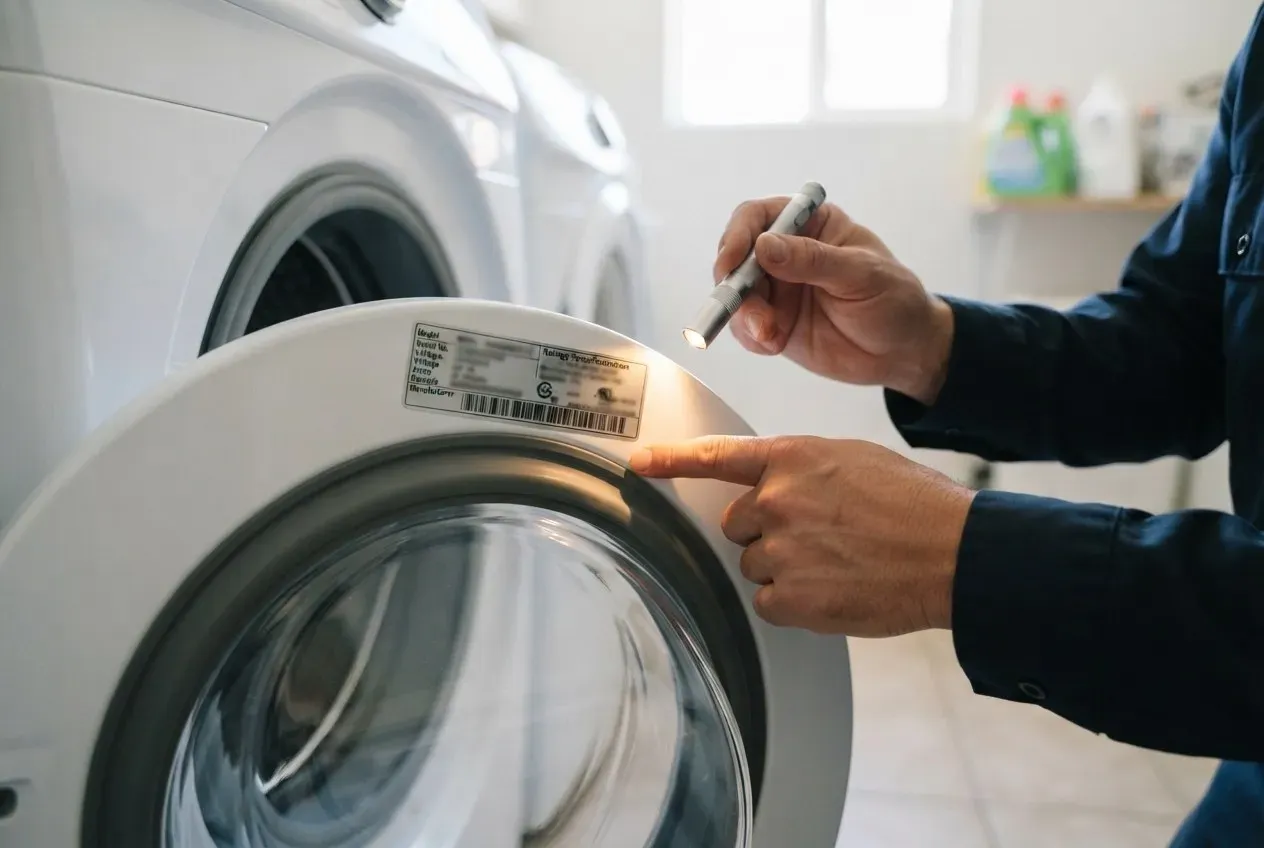
The model number is the other half. Look for the rating plate inside the door, on the door frame or on the back of the cabinet. Code sets change from one series to the next, so identical letters can mean two different faults on two machines from the same maker. When you call, have three things ready: the code, the model number, and which stage the appliance was in when it stopped (fill, drain, heat, spin, or idle).
No display? Count the flashes and the beeps
Machines without a screen still report faults. A Whirlpool dishwasher with status lights flashes the code: a run of quick flashes for the F number, a short pause, then a second run for the E number, with a longer pause before it repeats. Seven flashes, a pause and one flash is F7E1. Whirlpool also notes that not every blink is a fault, since all the cycle lights flash when the door was opened mid-cycle.
Bosch dishwashers can beep instead. Bosch says three beeps usually mean water pooling in the base, and five beeps often mean the same water has tripped the leak sensor. A blinking red light on the floor under a Bosch means it stopped with a problem rather than finished. Count the flashes or beeps twice, then read them to us with the model.
Leak, heat, refrigerant or gas: stop using it
Plenty of codes can sit until the visit. This group shouldn’t. Either the maker tells owners to cut the water or power, or running the appliance with the fault can do further damage.
- Water on the floor or in the base: E15 on a Bosch or Thermador dishwasher, E:30-00 on a Bosch dishwasher, E:00-23 on a Bosch washer, AE or E1 on an LG dishwasher, AE on an LG washer, F8E4 on a Whirlpool dishwasher, LEAK DETECTED on a GE dishwasher, FE on a GE washer, and LE or 1E on a Samsung washer that has water underneath.
- Too much heat: F10 on a Frigidaire oven, F2 or F20 on a GE oven, HC or hE on a Samsung dryer, and on a Bosch wall oven any E code except E11, since Bosch says those mean disconnect the power.
- Refrigerant or compressor trouble: CL or CH on an LG fridge, 84C on a Samsung fridge, and EC50 or EC40 on a Sub-Zero when the inside is warming up. Keep the doors closed so the cold stays in.
What to do while you wait:
- For a leak code, close the appliance’s water valve. Pull the plug only if you can do it without standing in water.
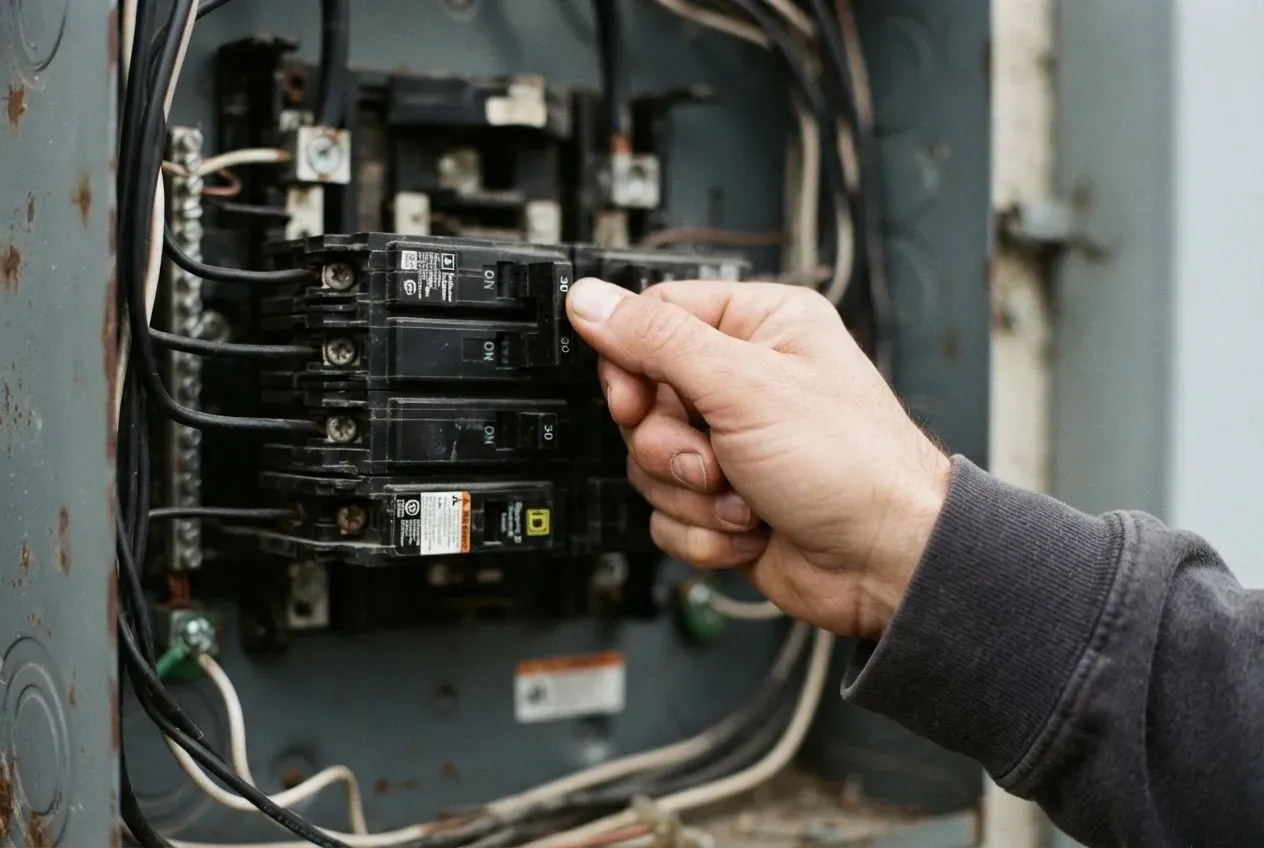
- For an oven or dryer running hot, turn it off and then flip its breaker.
- For any smell of gas, leave the house, then call 911 from outside. Leave light switches alone on the way.
- When the house is safe, give us a call and read us the code.
Sub-Zero Service light, EC40 and EC50, and Wolf F1
On a Sub-Zero, a Service indicator that flashes and one that stays lit mean different things. Tell us which one you’ve got.
| Display | Meaning | First checks |
|---|---|---|
| Service steady (600 or 700 Series) | Codes are saved in memory, and temperatures are still normal | Reading the saved codes off the control |
| Service flashing with EC50 | Refrigerator compressor running longer than it should | Condenser fan and coil, door gaskets, and the sealed system if the inside is warming |
| Service flashing with EC40 (600, 648PRO and 700 Series) | Trouble in the sealed system, a fan or a temperature sensor | Each fan and temperature sensor, then the sealed system |
| Red triangle in the Sub-Zero Group Owner’s App | An alert that Sub-Zero classes as a service issue | The fault that triggered it |
| dO Or flashing with a chime (Classic built-in) | Door open longer than five minutes | Nothing broken; if it shows with the door closed, the door switch and gasket |
If EC50 is up and the temperatures keep rising, don’t clear it, so the tech can see it. Our Sub-Zero repair page explains the sealed-system warranty, which can change the price of that job.
Wolf wall ovens: F1
F1 on a Wolf L Series wall oven means one of two things. Either the control didn’t sense the door lock switches (locking or releasing) within 60 seconds while the lock motor ran, or someone slammed the door during a heating mode. The tech tests the lock motor and its switches, then the wiring to the control. Wolf ovens and rangetops get more detail on the Wolf repair page.
Samsung washer, dryer and refrigerator codes
Samsung often has several spellings for one fault. Look down the first column for yours.
Samsung washers
| Code | Meaning | First checks |
|---|---|---|
| nF, 4C, 4E, 1 4C | Water isn’t coming in | The inlet valve, its screens, and the supply hoses and their valves |
| nF1, CE, 4C2, 4E2, 14C2 | Hot and cold hoses swapped | Hookups behind the washer; the inlet valve if the code won’t clear |
| SC, SE, 5C, 5E, nd, 1 5C | Water drains slowly or stays put | The drain pump, its filter, and the drain hose |
| 0E, OE, 0C, OC, 1 OC | Drum holding too much water | The drain, the inlet valve and the water level sensor |
| LE, 1E, LC, 1C, LC1, 1 LC | Leak found, or the water level is off | Level sensor, pump and tub seals, and every hose |
| dE, dE1, dE2, dS, d5, dC, dC1, dL, FL, LO | Door or its lock isn’t secured | How the hinge lines up, the lock assembly and the latch |
| Ub, U6, Ur, UE, dc, 1 Ub | Clothes bunched to one side | Nothing broken at first; shocks and suspension if spins keep cutting out |
| Sd, 5d, SUd, 5UD, SUdS | Suds built up and the cycle paused for them to drop | Nothing broken |
| E3, 3E, 3C, 1 3C | Problem with the motor | Motor control, wiring, and the drive motor itself |
| HE, HE1, HC, Hr, 1 HC | Problem with the heater | The wash heater circuit |
| tC, tE, tE1 | Problem with the temperature sensor | The water temperature sensor and its wires |
| bE2, BE2, 6E2, 8E2, E2 | Control reads a button as held down | Control board and front-panel keys |
Samsung dryers
| Code | Meaning | First checks |
|---|---|---|
| Clg, Cl9, C9, C80, C90, Ct | Results from the vent blockage test | Every foot of the vent, up to the outside hood on the roof or wall |
| hE, HC, HC4, 1 HC | Running hot | Duct and vent blockages, the thermostats, then the burner or element |
| tC, tS, t5, tO, t0, tE, tE3, tC5, tCS | Temperature reading or sensor problem | Heating circuit, vent run and thermistor |
| 2E, 9E, 9E1, 9C1 | Incoming voltage out of range | The dryer’s circuit, the cord hookup and the outlet |
| d0, do, dC, dE, dF, 1 DC, 1 dF | Door sensor, latch or door | Latch and door switch |
| Et, AC, AE, AE3, AE4, AE5, EEE, E3, 1 AC | Boards inside can’t talk to each other | Harness between the boards first, then the boards themselves |
| FE, FC, 1 FC | Power frequency invalid | Main control and the incoming supply |
| 6E, 6E2, 6C2, bE, bE2, bC2 | Control reads a button as held down | Keys on the control panel |
| dn | Firmware is downloading | Normal; worth a call only if it’s still there a day (24 hours) later |
A dryer’s heat or temperature code may really be a vent problem, so the tech looks at the vent run before changing any sensor. Tell us if the duct is long, crushed or made of foil. A no-heat visit is covered in full on the dryer repair page.
Samsung refrigerators
| Code | Meaning | First checks |
|---|---|---|
| 84C | Compressor locked up | The compressor’s start circuit and the compressor |
| 83E | Compressor drawing abnormal current | Inverter board, wiring and compressor |
| 85E, 86E | Compressor voltage too low or too high | Inverter board and the voltage at the wall outlet |
| 85C | Voltage detected as low | The outlet’s supply |
| 21E | Fault with the freezer fan | Any ice on the evaporator, and the freezer fan motor |
| 22E, 22C | Fault with the fridge fan | Frost around the fridge fan, and its motor |
| 5E | Fault with the fridge defrost sensor | Defrost heater and defrost sensor |
| 8E, 14E | Fault with the ice maker sensor | The ice maker assembly and its sensor |
| 33E | Fault with the ice pipe heater | The heater on the fill tube |
| 39E, 39C | Ice maker not working as it should | Ice maker assembly and motor |
| 40E, 40C | Fault with the ice room fan | Frost in the ice compartment, and the fan there |
| 76C | Water sensed in the AutoFill compartment | The AutoFill pitcher hookup and the supply line |
| 88 88 | Fault in communication | Wires from the main board to the display |
| PC ER, PC CH | Communication error, often after a power surge or when a door isn’t properly connected | Both boards, and the harness running through the door hinge |
| OFF OFF, OF OF, O FF | Cooling Off (demo) mode, so nothing is cooling | Nothing broken |
For its ice maker codes, Samsung gives owners nothing to try, because every one is a service code. See ice maker repair for those visits and Samsung repair for warranty terms.
LG washer, dryer, refrigerator and dishwasher codes
LG washers
| Code | Meaning | First checks |
|---|---|---|
| AE | Water leaking inside the cabinet | Pump and tub seals, and the hoses inside |
| FE, E04, E12 | Too much water coming in | Water level sensor and inlet valve |
| IE, E02, E10 | Too little water coming in | Inlet valve, inlet hose and supply valves |
| OE, E03, E21 | Water won’t drain | Pump filter, drain pump and drain hose |
| PE, E33 | Fault with the water level sensor | The pressure sensor and the hose to it |
| dE, dE1, E01 | Door isn’t fully closed | Door switch and door latch |
| dE2, E30 | Door closed, lock not engaged | The door lock assembly |
| LE | Motor can’t spin the tub | The direct-drive motor’s rotor and sensor |
| CE | Motor circuit drawing too much current | Wiring, motor control and motor |
| tE | Fault with heating | Thermistor and heater |
| UE | Clothes bunched to one side | Nothing broken at first; drum and suspension if it keeps stopping |
| PF | Power cut out during a cycle | Nothing broken; check the supply if it happens again |
| SUD | Suds built up | Nothing broken |
| CL | Child lock is set | Nothing broken |
LG dryers
| Code | Meaning | First checks |
|---|---|---|
| d80, d90, d95 | Airflow blocked somewhere between the dryer and the outside exhaust (on gas models, d80 can also mean the gas supply is low) | Outside hood and duct run, plus gas supply on a gas dryer |
| GAS | Dryer isn’t detecting gas | Gas valve, flame sensor, igniter and the supply |
| nP | Heater isn’t getting current | Heater circuit, the 240V outlet and the cord |
| PS | Voltage in the power cord isn’t right | How the cord is connected at the terminal block |
| tE1, tE3 | Fault with the thermistor | Its wiring and the thermistor |
| tE2 | Thermistor fault when the room is cold | The lint path and the thermistor |
| HS | Fault with the humidity sensor | Wiring and the moisture sensor bars |
| dE | Door isn’t shut all the way | Whether the lint filter is seated, and the door switch |
| F0 | Lint filter isn’t in position | With the filter properly in, the filter sensor |
LG refrigerators
For most LG fridge codes there’s nothing for the owner to do; LG treats them as service codes.
| Code | Meaning | First checks |
|---|---|---|
| CL, CH | Refrigerant leaking on the low side or high side | Sealed system |
| FU | Freezer isn’t getting colder the way it should | Blocked vents, door gaskets, and whether the compressor runs right |
| FF (Er FF, E FF) | Freezer fan running abnormally | Evaporator frost and the freezer fan |
| rF (Er rF, E rF) | Fridge-side fan running abnormally | Frost around the fridge fan, and the fan |
| CF | Fault with the condenser fan | The condenser fan motor |
| dH, FdH, dHF | Temperature didn’t come up in time during defrost | Defrost drain, temperature fuse and defrost heater |
| FS, rS, r2, dS, rT | One of the temperature sensors has faulted | Whichever sensor the code names, plus its wiring |
| IF, IS, It | Fault with the ice maker fan, sensor or motor | Whichever ice maker part the code names |
| gF | Fault with the water flow sensor | Flow sensor, water pressure, kinked lines and the supply valve |
| CO, C1 | Boards aren’t communicating | Wires linking the dispenser, display and main board |
| OFF | Demo or display mode, cooling turned off | Nothing broken |
When you see FF, rF, CL or CH, the fridge is losing its cold. The usual symptoms that go with it are on the refrigerator and freezer repair page, and the LG repair page explains LG’s compressor warranty.
LG dishwashers
| Code | Meaning | First checks |
|---|---|---|
| AE, E1 | Leak inside set off the float switch | The float, pump seals, door gasket and hoses |
| OE | Water won’t drain | Drain pump, drain hose and filter |
| IE | Not enough water after the fill | Inlet valve, inlet line and supply valve |
| PE | Fault with the water level sensor; LG says it takes a technician | The level sensor |
| HE | Water not heating, or heating too much | The heater circuit |
| tE | Fault with the temperature sensor | The thermistor |
| LE | Fault with the wash motor | Its wiring and the wash motor |
| nE | Trouble with the Vario pump | Diverter and Vario motor |
| F31, F35 | Heat dry fan fault or heat dry temperature fault | The dry fan’s sensor and the fan |
| bE | Oversudsing, usually from hand dish soap | Nothing broken once the suds are gone |
Bosch and Thermador dishwasher codes, starting with E15
Bosch and Thermador describe these dishwasher codes the same way, so a single table works for both. E15 needs attention right away, because it means water is sitting in the base.
| Code | Meaning | First checks |
|---|---|---|
| E15 | Leak protection has found water in the base | Where the water came from (door gasket, pump seals, hoses), then the float switch |
| E24 | Water not draining because the filter, hose or pump is blocked | Drain pump, filter and drain hose |
| E25 | Drain pump is blocked or its cover is loose or gone | The drain pump cover and pump |
| E22 | Filter is blocked | Sump and filter |
| E16, E17 | Trouble filling with water | Inlet valve and inlet hose |
| E18 | Not enough water in the tub | Flow meter, inlet hose and supply |
| E14 | Fault with the flow meter or the water coming in | The flow meter |
| E12 | Heat pump has limescale in it | Scale in the heat pump |
| E04 | Self-test found a fault in the heater electronics | The control and heater circuit |
| E27 | Not enough voltage coming in | The dishwasher’s supply circuit |
| E01, E02, E03 (Bosch) | Faults in the heater circuit, a relay or the heat pump | Relays on the control and the heater circuit |
San Jose Water rates its groundwater at about 10 to 26 grains per gallon, and water counts as hard above 7 grains, so the scale that E12 reports is common here. If E12 keeps returning, mention it when you call. Hard-water trouble gets fuller treatment on the dishwasher repair page, and the Thermador repair page covers that brand’s warranty.
Bosch-only dishwasher codes
Only Bosch publishes these, so they may not hold for a Thermador.
| Code | Meaning | First checks |
|---|---|---|
| E23 | Drain pump is clogged, blocked or failed | The drain pump |
| E20, E21 | Fault in the heat pump heater, or the heat pump is blocked | The heat pump heater and heat pump |
| E19 | Fault in the detergent dispenser solenoid circuit | The solenoid on the dispenser |
| E07, E10 | Fault in the CrystalDry (zeolite) fan motor or chamber heater | The chamber heater and drying fan |
| E06 | Fault in the door sensor circuit | The door switch |
| E05 | Fault in the circuit for the wash arm diverter | The diverter’s wiring and motor |
| H01 | One-hour delay start is set | Nothing broken |
Recent Bosch models show codes as E:xx-xx. Under that format, E:32-00 is a fill problem, E:61-03 is a drain problem, and E:30-00 means the water protection system has tripped. There’s a separate page for Bosch dishwashers too: Bosch repair.
Bosch washers, cooktops and wall ovens
In the US, Bosch laundry means 24-inch compact machines. Some of the cooktop codes describe a passing condition such as heat or demo mode.
| Appliance | Code | Meaning | First checks |
|---|---|---|---|
| Washer | E:00-23 | Water found in the base | Wherever the leak starts |
| Washer | E18, F18 | Drain hose kinked or blocked | Pump, filter and drain hose |
| Washer | E17, F17, F29 | Low water pressure or clogged inlet filters | Inlet valve, supply pressure and inlet filters |
| Washer | E16, F16, E34, F34 | Door isn’t locked | The door lock |
| Washer | E32, F32 / E33, F33 | Load off balance / foam built up | Nothing broken; the suspension if it keeps happening |
| Washer | E80 | Fault in the drive circuit | Motor control and motor |
| Cooktop or range | F2, F4 | The electronics got too hot | Airflow under the cooktop and the cooling fan |
| Cooktop or range | F5 | A hot pan is near the controls | Nothing broken |
| Cooktop or range | U400, E9000, E9010 | Supply voltage isn’t correct | Wiring feeding the cooktop |
| Cooktop or range | dE | Demo mode is on | Nothing broken |
| Wall oven | E11 | Touch keys don’t respond, possibly due to condensation | The keys on the control panel |
| Wall oven | Any other E number | An internal fault; Bosch says disconnect the power | Whatever fault the code identifies |
Thermador wall ovens and ranges
Thermador ovens show a fault as an E followed by a number, with the control beeping. Thermador’s own guidance is to press any key to stop the beeping, reset the oven, and turn it off if the code comes back. E0211, E1601 and E0510 are different: they show up during a Home Connect software update, and the update is what they’re reporting. For any other E code, write down every digit and read it to us with the model, and the tech tests the sensor, lock or control the code points to. The Thermador repair page covers that brand’s ranges and warranty.
Whirlpool codes read as an F half and an E half
Whirlpool codes have two parts. The F number names the system, and the E number names the fault inside that system. So F9E1 is the drain system saying the drain took too long.
Whirlpool washers and dryers
| Code | Meaning | First checks |
|---|---|---|
| F9E1 (top and front load) | Drain is taking too long | The pump, the pump filter on front-loaders, and the drain hose |
| F8E1, LF, Lo FL (top and front load) | Not enough water getting in | Inlet screens, hoses and faucets, plus whether the drain hose sits more than 4.5 inches down the standpipe |
| F5E2 (top load) | The lid lock can’t engage | Anything jammed in the lid lock, and the lock |
| F5 E2 (front load) | The door won’t lock | The door lock |
| F5E3, F7E1 (top load) | Lid lock fault or some other internal fault | The control, the motor and the lid lock |
| F7 E1 (front load) | Error sensing the motor speed | Whether the shipping bolts were taken out on a new install, then the motor and its sensor |
| F0E5 (top load) | Load is off balance | Nothing broken; the suspension if it repeats |
| F0 E2, Sd, Sud | Suds built up | Nothing broken |
| F3 E1 (dryer) | Exhaust thermistor | The exhaust thermistor’s wiring and the part |
| F4 E3, AF, Check Vent (dryer) | Airflow is restricted | The entire vent path from the dryer out to the hood |
Whirlpool points out that the dryer itself may be fine when F4 E3 shows, because the blockage can be in the home’s vent. The brand’s warranty is covered on the Whirlpool repair page.
Whirlpool dishwashers and ranges
| Code | Meaning | First checks |
|---|---|---|
| F8E4 (dishwasher) | Water has collected in the drip tray | Where the leak starts, and the hose connections |
| F9E1 (dishwasher) | Drain is taking too long | On a new install the disposal knockout plug, then the air gap, drain hose and filter |
| F6E4 (dishwasher) | The water float switch | Whether the unit is level, and the float switch |
| F1E1, F2E1, F7E2 (dishwasher) | The control module, a key that’s stuck, or the wash motor | Wash motor, keypad and control |
| F3 E0 (range) | Control, wiring or oven temperature sensor | The control, the oven sensor and its wiring |
| F2 E0, F2 E1 (range) | Control, wiring or keypad | The control, the ribbon cable and the keypad |
| F9, F9 E0 (oven) | Electrical noise on the line, or the supply wires swapped | The wiring at the oven’s terminal block |
GE oven F codes, dishwasher C codes and washer messages
On GE ovens, the F code usually names the part in question.
GE ranges and wall ovens
| Code | Meaning | First checks |
|---|---|---|
| F3, F4 | The oven sensor; GE says to replace it | Wiring and oven sensor |
| F2, F20 | Oven heat passed a preset limit | Relays on the control, and the oven sensor |
| F0, F1, F6, F7 | Keypanel fault; GE says the keypanel often has to be replaced | The keypanel and where it plugs into the control |
| F5, F8, FF | The electronic control | Control board |
| F9, FC | A part in the door lock circuit | The lock motor and its switches |
| FD | The probe or its receptacle | The jack and the probe |
| Bad Line | Wiring to the range is incorrect | Supply connections at the terminal block |
| LOC | Control lock is on | Nothing broken |
GE dishwashers and top-load washers
| Code | Meaning | First checks |
|---|---|---|
| LEAK DETECTED (dishwasher) | There’s a leak | Where the water is coming from |
| C3 (dishwasher) | Water won’t drain | The drain path and the drain pump |
| C1 (dishwasher) | Pumping out took more than two minutes | Drain pump, disposer connection, drain hose and air gap |
| C4 (dishwasher) | The float might be stuck | Sump and float |
| C6 (dishwasher) | Water coming in is below 120°F | The dishwasher’s heater and its hot water supply |
| C7 (dishwasher) | The temperature sensor circuit | Wiring and sensor |
| H2O (dishwasher) | Water is low | Inlet valve, whether it’s level, and the hot water valve |
| FE (washer) | Water has hit a critical level | Level sensor and inlet valve |
| H2O SUPPLY, IE (washer) | Water isn’t coming in | Inlet valve and supply valves |
| UE (washer) | Off balance | Nothing broken; suspension and leveling if it repeats |
These washer messages are for GE top-loaders from 2017 on, which GE says have its Consumer Help Indicator. For how GE, Profile and Monogram warranties compare, see the GE repair page.
Frigidaire range, dishwasher, washer and fridge codes
Frigidaire ranges and dishwashers
| Code | Meaning | First checks |
|---|---|---|
| F10 (oven) | Thermal runaway (the oven ran too hot) | Control relays and the oven sensor |
| F30, F31 (oven) | Temperature probe is shorted or open | Wiring and oven sensor |
| F90 to F94 (oven) | Trouble with the door lock | Lock switch and lock motor |
| F1, F3, F12, F13, F20, F26 | Fault in the keypad, communication or control | Control, wiring and keypad |
| F40, F41, or a dash (cooktop) | The cooktop is locked out | Nothing broken |
| i20 (dishwasher) | Water didn’t drain | The pump, filter, glass trap, disposal knockout plug, and a drain hose loop at least 32 inches high |
| i40 (dishwasher) | Sump or filter clogged | Sump, filter and glass trap |
| Cd, CL (dishwasher) | The door isn’t latched | The latch |
| HO, Hd (dishwasher) | Cycle waiting while the water heats | Nothing broken |
Frigidaire washers and refrigerators
| Code | Meaning | First checks |
|---|---|---|
| E1 (top-load washer) | Filling slowly | Inlet valve, hose screens, hoses and faucets |
| E2 (top-load washer) | Draining slowly | Pump, standpipe height and drain hose |
| E3 (top-load washer) | Lid is open or the lid lock has failed | Whether it’s level, and the lid lock |
| E4 (top-load washer) | Off balance in the spin | Suspension, any shipping foam left from a new install, and leveling |
| H, HI (refrigerator) | Warm for longer than an hour | Door gaskets first, then fans and the sealed system if it doesn’t come back down |
| DI SP (refrigerator) | Ice is jammed in the chute | Dispenser, auger and ice chute |
| 77 (refrigerator) | Demo mode is on | Nothing broken |
The Frigidaire repair page has that brand’s warranty terms.
A code narrows the search, and a meter confirms it
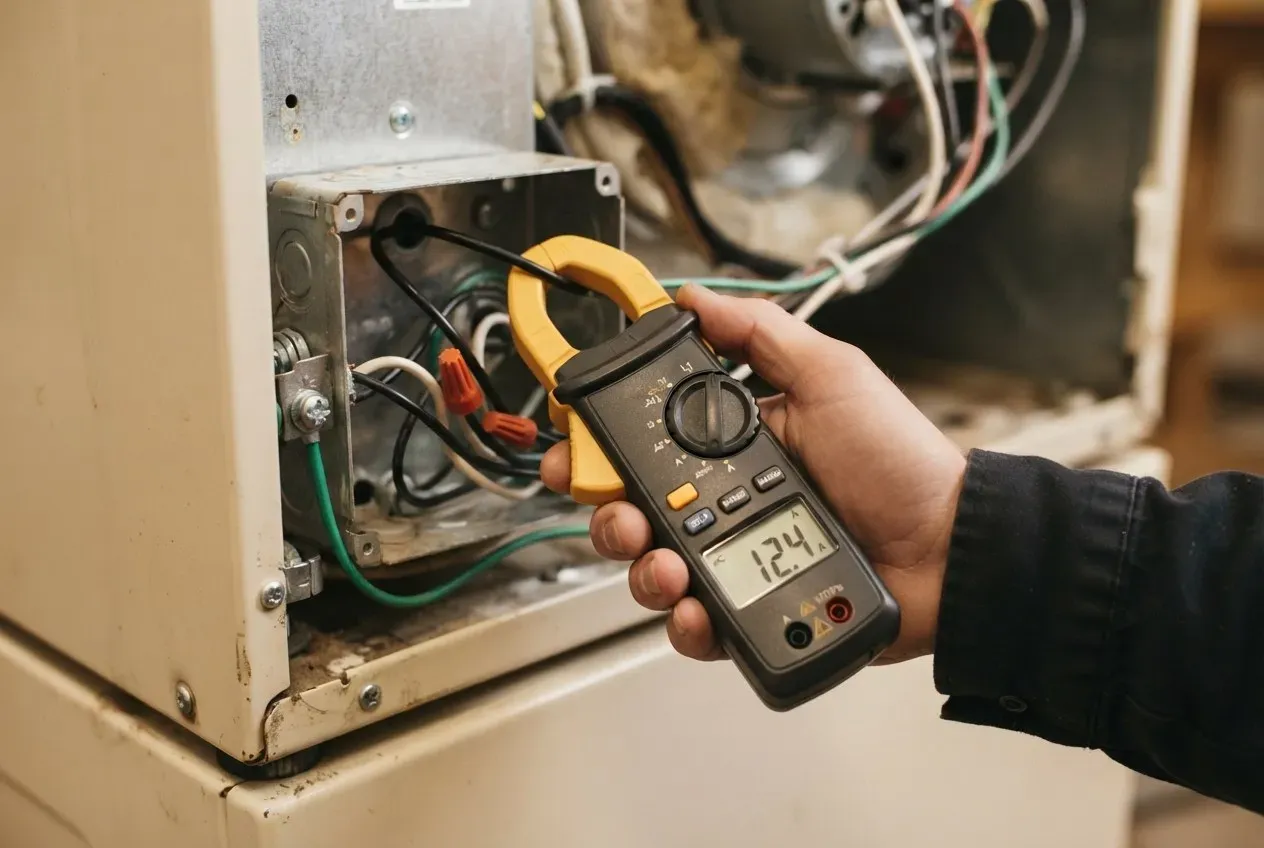
A code tells the tech which circuit to look at, but the failed part isn’t always the one it names. With a sensor code, the trouble might be in the sensor, the wiring or the board that reads it, and the tech puts a meter on the circuit to find out before swapping parts. Once the fault is confirmed, you see the price in writing, and you decide whether the repair goes ahead.
If the appliance is older, the appliance repair cost guide lists what common repairs run, and the repair or replace guide helps you weigh a fix against buying new. When you’re ready, call and read us the code so the tech knows which part to test first.