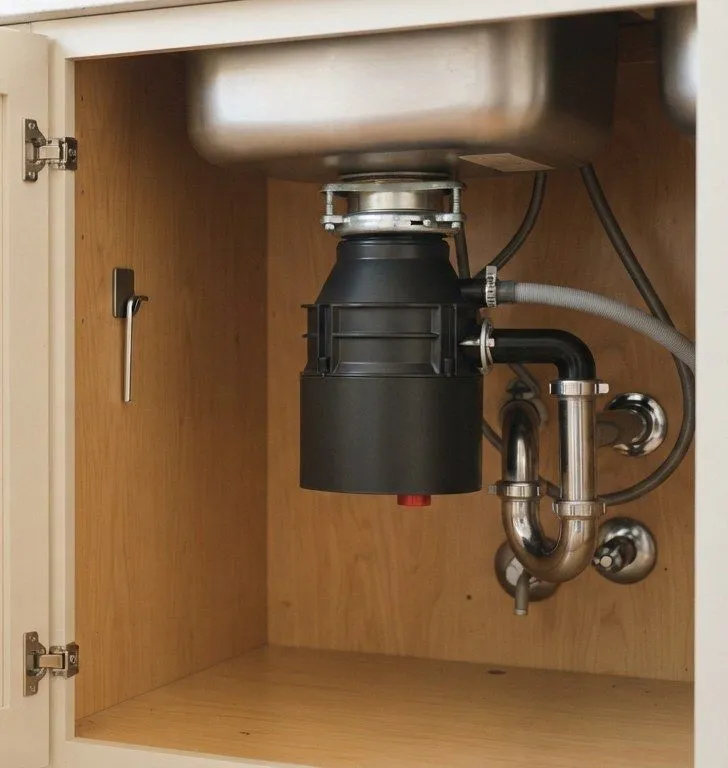
San Jose Appliance Care takes calls for garbage disposal repair in San Jose, from a jammed grinding plate to a leak in the sink cabinet or a dishwasher that won’t drain through the disposal. Under the sink, the disposal is a motor turning a grinding plate against a grind ring. It hangs from a mounting assembly at the sink flange, sends waste out a discharge tube to the drain and, in most kitchens, takes the dishwasher’s drain hose at a side inlet. A registered, insured tech repairs InSinkErator, Waste King, Moen and GE disposals or puts in a new one. Whatever it’s doing, keep your hand out of it. InSinkErator says that holds at all times.
Humming, but the plate won’t turn
A hum means the motor has power and the plate is stuck. Most of the time something hard has lodged between the plate and the grind ring: a fruit pit, a bone, a bottle cap or broken glass. Stringy scraps jam it too. InSinkErator rates its Advanced Series for tougher waste like bones, celery and corn cobs, which a basic model isn’t built for.
Turn it off and keep it off. A motor straining against a jam heats up until the overload protector shuts it down. The tech clears the jam from underneath, removes whatever caused it and looks over the plate, lugs and grind ring before running the unit again. When the plate still won’t spin with the jam gone, the bearings or the motor may have seized, and the talk turns to a replacement.
Garbage disposal won’t start at the switch
Total silence usually comes down to two things. Either power isn’t getting to the motor, or the overload protector has tripped. That protector is a red button on the underside of the unit, facing the floor, and InSinkErator builds it to cut the disposal off when something goes wrong, like a jam.
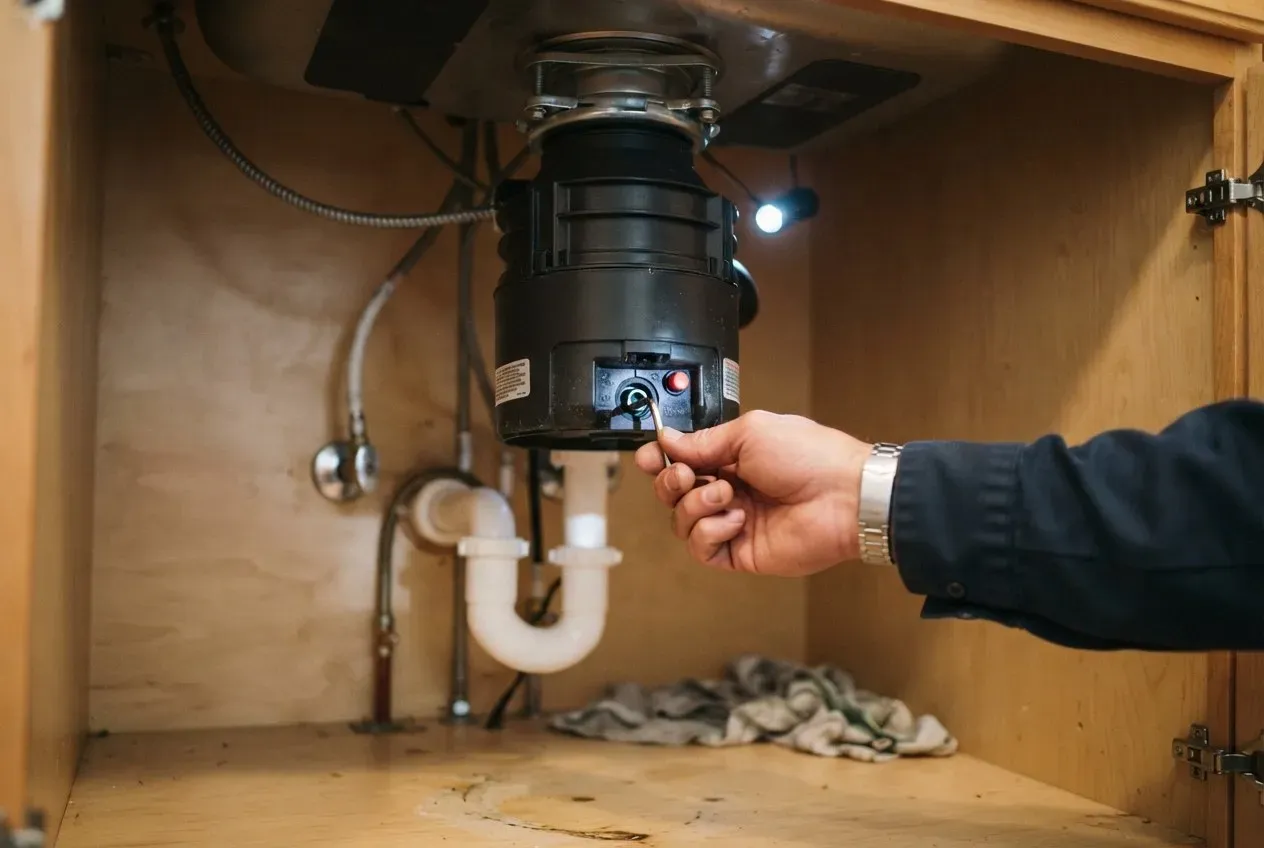
The tech checks the protector before anything else, then follows the power: the wall switch or button on the countertop, the cord and outlet in the cabinet, or the wire connection on a hardwired disposal. A protector that trips over and over is reacting to something, often a partial jam or a motor running hot. The tech traces what’s setting it off. Let us know whether yours plugs in or is wired in, how it’s switched on and how often it cuts out.
Grinding, rattling or a metallic noise
A metal clatter usually means something hard is loose in the grind chamber. A spoon, a coin or a screw is the usual find, and InSinkErator names coins and screws among the things that turn up stuck in a disposal. Switch it off at the wall and leave it off rather than running it to “grind it through.”
On the visit the tech pulls whatever is in there and checks that the two impellers on the plate still swing freely, since they move the food around the chamber. A deep rumble or a grinding sound with the chamber empty points somewhere else: worn bearings or a loose mount, and that’s usually when a new unit comes into the conversation.
Garbage disposal leaking under the sink
Where the drip shows up points the tech to the joint that’s failing. InSinkErator groups disposal leaks by location:
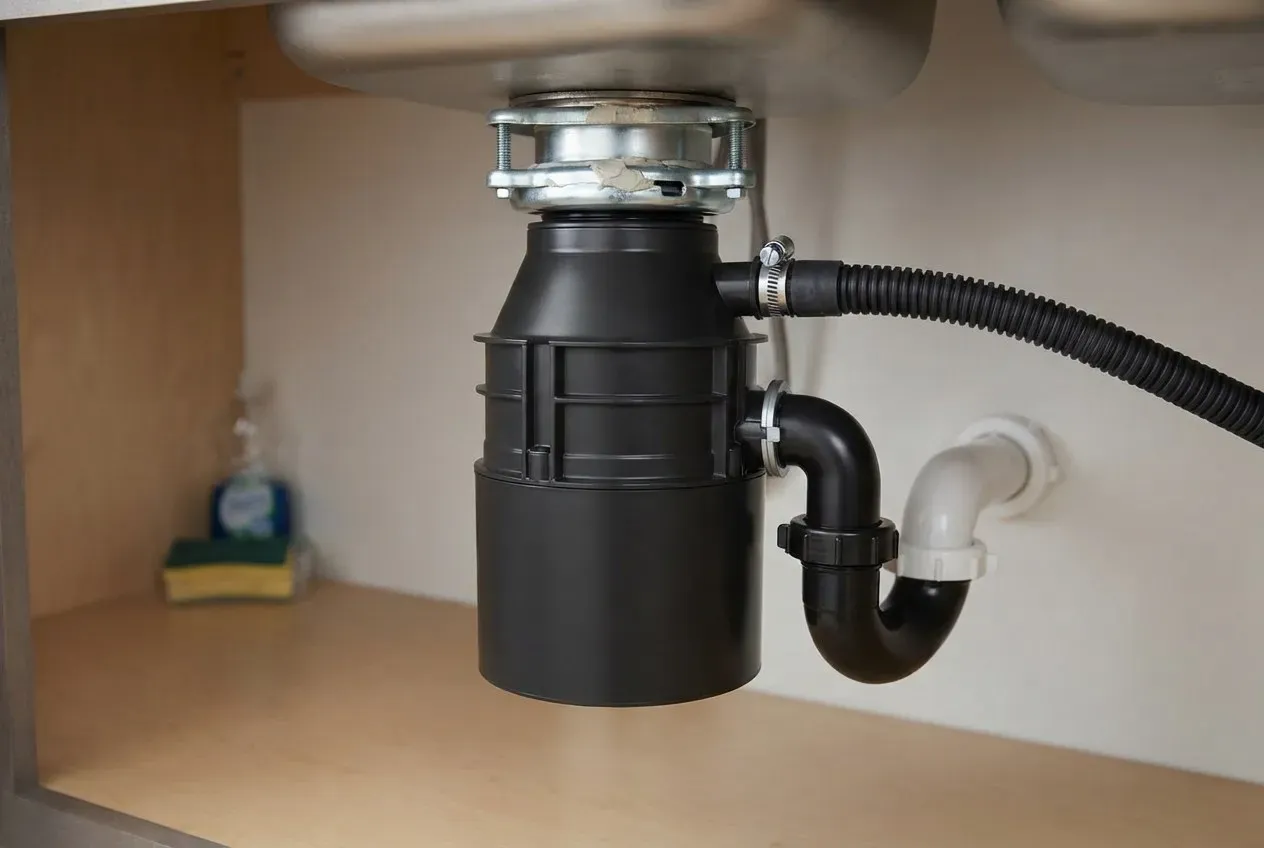
- Top: around the sink flange and the mounting assembly holding the disposal up.
- Side: at the discharge tube where it leaves the disposal for the drain.
- Dishwasher inlet: where the dishwasher drain hose is clamped on. A loose clamp is the first thing to rule out.
- Bottom or body: InSinkErator says to make sure the water isn’t running down from the mount first, since a top leak can drip off the base and look like a bottom leak.
If the water really is coming through the housing, the leak is inside the unit, not at a joint, and the tech tells you whether that disposal is still a good repair. Timing narrows it down too. Say whether the drip starts as the sink drains, while the disposal runs or when the dishwasher pumps out.
Slow drain, or the sink backing up while it runs
A disposal can grind fine and still leave water standing in the bowl. The tech works out whether the clog is in the unit or in the drain pipe beyond it, using the same check InSinkErator gives: a whirlpool in the sink while the disposal runs points to a blocked drain past it, and no whirlpool points to a jam inside the disposal.
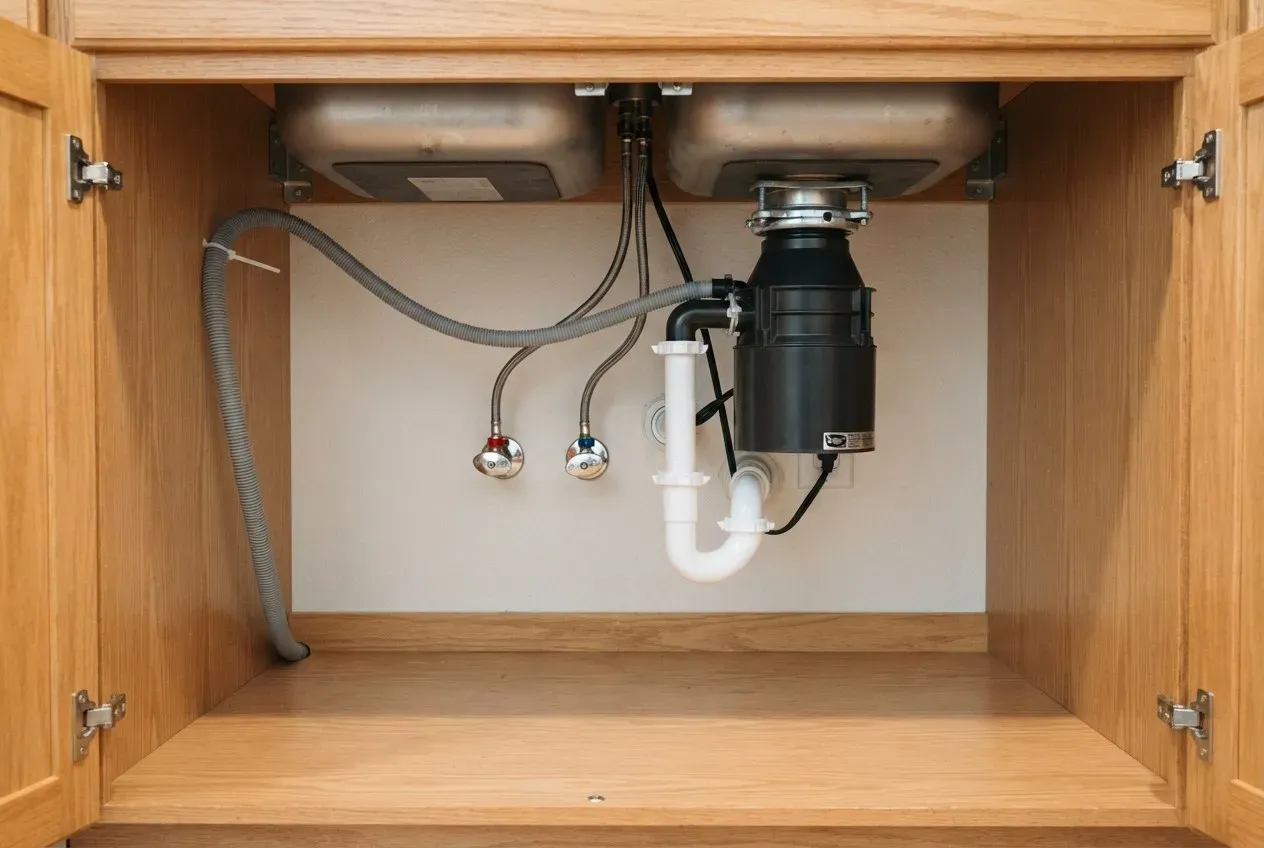
Grease is the usual reason a line past the disposal narrows over time, and the FAQ below answers the grease question. Tell us whether one bowl backs up or both, and whether the dishwasher drains into the same line.
Bad smell from the garbage disposal
Built-up food is the usual cause. InSinkErator says scraps collect in the grind chamber and under the rubber splash baffle at the top, and they sour there between uses. A disposal that only runs now and then smells worse than one that runs every day.
Smell on its own is usually that buildup. Smell along with slow draining or water left in the bowl is a reason to call, because the food is probably packed in somewhere it can’t flush out, either in the unit or the pipe past it. Mention both when you call.
Dishwasher full of water since the new disposal went in
Check the knockout plug first. InSinkErator ships its disposals with a small plug sealing the dishwasher inlet, and it has to be knocked out before the drain hose goes on. With the plug still there, the dishwasher has nowhere to pump, and the tub sits full after every cycle. The tech pulls the hose, clears the inlet and clamps the hose back down tight.
When the disposal side checks out and the tub still won’t empty, the fault is likely in the dishwasher. Our dishwasher repair page picks it up from there.
Repair the disposal or put in a new one
Repairs cover a jam that left the grind parts intact, a loose mount or discharge joint, a worn switch or a bad cord. A seized motor, water seeping through the body or a protector that trips with no jam in sight usually means a new disposal.
If yours is still under warranty, mention it on the call. InSinkErator’s in-home coverage depends on the model. Either way the price is in writing before the old disposal comes out, and you only pay for work you agreed to. The appliance repair cost guide explains what moves the price, and the repair or replace guide runs the same reasoning for the rest of the kitchen.
Garbage disposal replacement and installation
When the old unit is done, the tech takes it out and puts the new one in on the same mount where it fits, or a new mount where it doesn’t. A few choices decide which disposal goes in:
- Horsepower. InSinkErator’s household range runs from 1/3 HP on the Badger 1 up to 1.0 HP on its top Power and Evolution models. More power grinds tougher scraps with fewer jams, which matters in a kitchen that cooks every night.
- Continuous feed or batch feed. Continuous feed runs from a wall or air switch for as long as it’s on, and it’s the common type. Batch feed only runs with its cover in the sink opening, so nothing can fall in while it grinds.
- Noise. InSinkErator’s SoundSeal models are built to run quieter than its standard Badger line, a point people notice in open kitchens.
- Cord or hardwire. A replacement should match how the old one got power. Some InSinkErator models come with both a cord and a hardwire adapter.
Say on the call what’s there now, whether it’s switched at the wall or with an air button on the counter, and whether the house is on septic.
Disposal repair around San Jose
Calls come in from all over San Jose and from nearby Sunnyvale, Fremont and Milpitas. Say which city you’re in, the brand on the label and whether the dishwasher drains through the disposal.