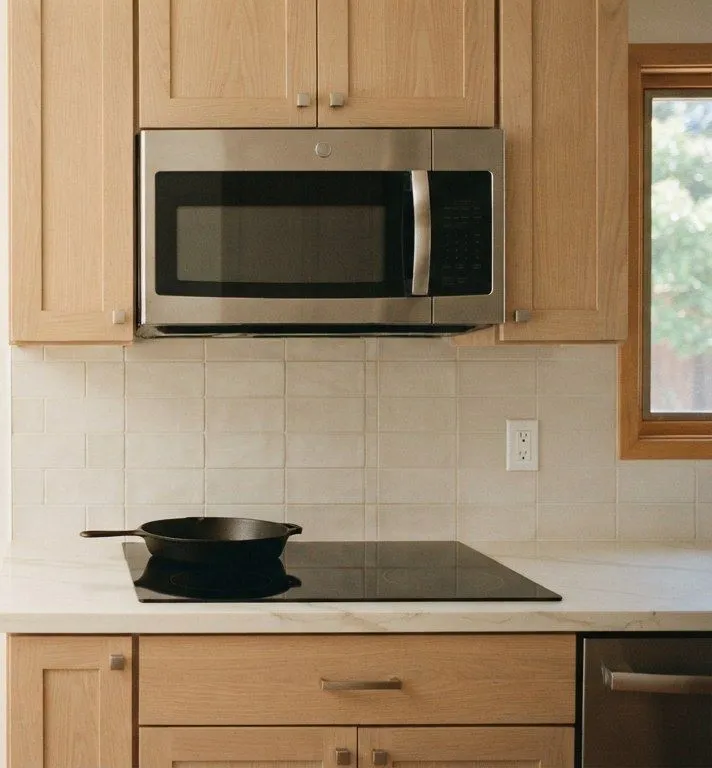
When you call San Jose Appliance Care about cooktop or microwave repair in San Jose, the first question is what you’ve got. A cooktop might be a gas rangetop, gas on glass, a radiant glass top, induction or an older coil top. Some cooktops have a downdraft vent that pulls smoke down through the counter. A microwave might hang over the range, sit built into a trim kit, slide out as a drawer, double as a speed oven or convection wall oven, or stand on the counter. Each cooktop fails in its own spot (spark ignition on gas, the element under the glass on radiant, the electronics on induction), so your answer tells the registered, insured tech what to bring. Microwaves have a high-voltage section that only a tech should open.
Cracked glass on the cooktop
Turn the zones off and leave them off. GE’s guidance applies to every glass cooking surface, whether radiant, induction or gas on glass: a cracked or pitted top shouldn’t be used until it’s repaired. On a range, GE wants the oven left off too, since its vent exhales through the rear or the backsplash right onto the glass.
Replacement glass is made for one specific model. That makes the model number the most useful thing you can give us on this call. Keep it handy, and say which part of the top is cracked and whether the zone there still gets hot.
Gas burner clicks but the flame never catches
GE traces most gas ignition trouble to a few causes. A burner head can be clogged from a spillover or from cleaning, or moisture can be sitting in the ignition and flame ports. The electrode might not sit flush with the cooktop, or a burner head or cap has ended up on the wrong burner. A wet burner keeps clicking without lighting until the ports dry. If the clicking began right after a cleaning or a boil-over, mention it, since that’s the first thing the tech rules out.
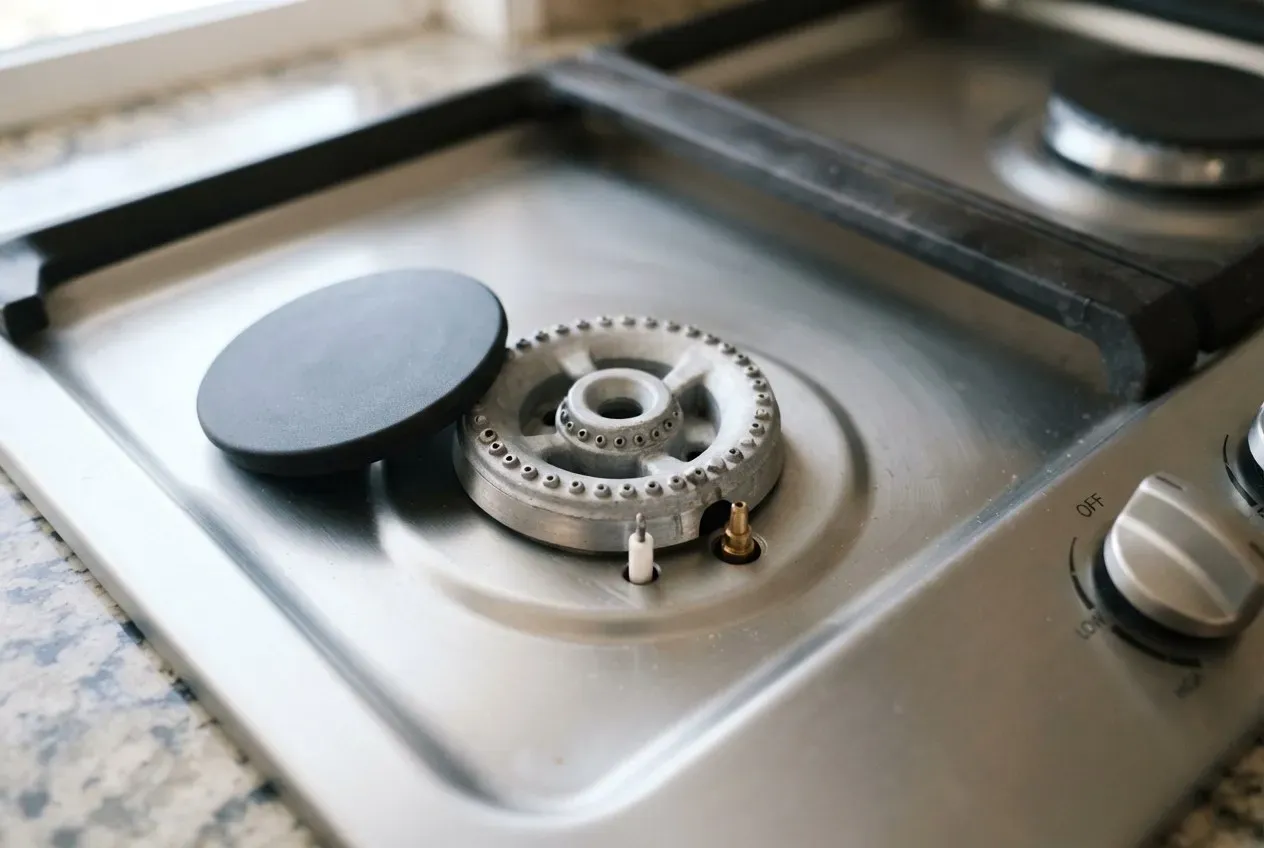
It helps to know whether one burner clicks or every burner does, and whether the clicking carries on with all the knobs turned off. Those two answers separate a fault at one burner from a spark module that fires every igniter at once. GE also lists igniters that don’t click at all as a reason for a service visit. A gas smell at the cooktop is another matter, and the safety steps for it are on our oven, range and stove repair page.
Induction zone won’t start with a pan on it
An induction zone heats the pan directly through a magnetic field, so it only switches on when it detects a pan it can work with. The useful test is whether that same pan heats on the other zones. If it does, the fault is confined to one zone, either its induction coil or the part of the power board driving it. If no zone starts at all, the tech goes to the power board and the control. Write down any code on the display along with the model number.
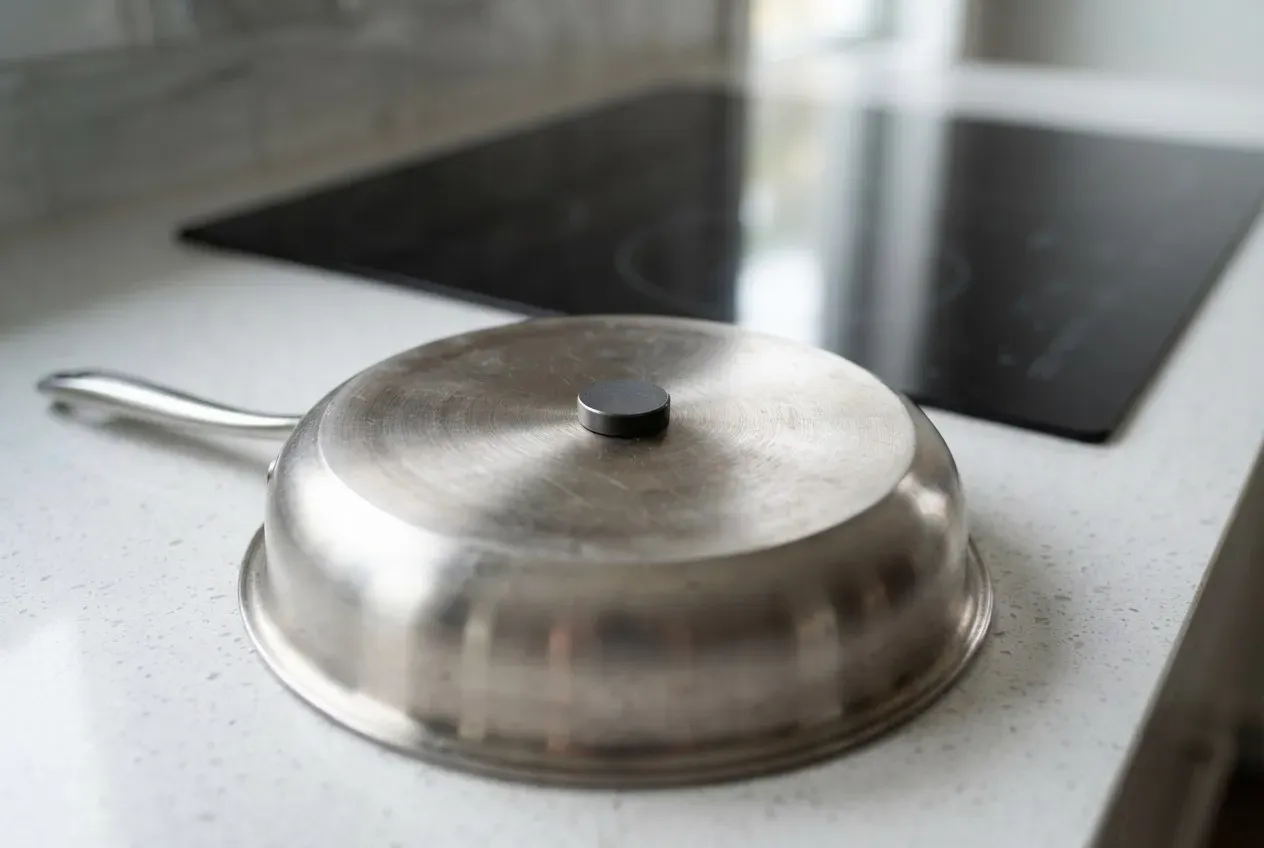
Induction electronics vary from maker to maker, and built-in cooktops from Thermador and Wolf run on their own parts. Give the brand when you call.
Radiant element won’t heat, heats unevenly or won’t turn off
Under a radiant glass top, every zone has its own element, an infinite switch (or a touch control) that sets the heat, and wiring connecting the two. A zone that’s cold on every setting points to one of those, and the tech tests them one at a time. A zone that glows in patches, or cooks hot in one spot and cool in another, usually has an element that’s partly burned out. Ranges with exposed coils are covered on the oven and range page instead.
Element stuck on high
A zone that glows full on at every setting, or keeps heating with the knob off, usually has a failed switch or control. Don’t keep cooking on it. Turn the cooktop off at the breaker and leave it off until the tech has tested the switch, since a zone that won’t shut off can overheat whatever sits near it.
Microwave runs but won’t heat, or hums louder than it should
When the light comes on, the turntable spins and the hum sounds right but nothing warms up, the trouble is usually in the part of the microwave that generates the heat. That’s the magnetron and the high-voltage circuit feeding it: diode, capacitor and transformer, plus a fuse or thermal protector and the wire connection at the magnetron. A bad door interlock switch gives the same result, an oven that acts normal and never heats. A hum that turns into a loud buzz or growl points at the same high-voltage parts.
Don’t take the outer case off. Every microwave oven carries a federally required label limiting service to properly qualified personnel, and with good reason. That circuit reaches roughly 5,000 volts, and the capacitor stays charged to a dangerous level well after the cord comes out of the wall. On the call, give the brand and the mounting, and mention any buzzing, sparking or tripped breakers.
Microwave sparking or arcing inside
Stop the cycle with Clear/Off. GE calls sparks inside the oven arcing, and the usual causes are metal: foil, a twist-tie, a dish with a gold rim or a rack touching the wall. Sparks with nothing metal inside point somewhere else. On the side wall of the cavity there’s a panel that looks like cardboard, the waveguide cover. GE says the oven shouldn’t be used at all if that cover is missing, and a scorched or greasy cover can arc too. Replacing it is a service job.
Microwave buttons or touchpad not responding
Look at the display first. Many models have a control lock, and GE says an “L”, “LOC” or “LOCKED” there means the panel is locked, not broken. Holding Clear/Off for about three seconds unlocks it on GE models. If the panel still won’t take a press, or some pads work and others don’t, the touchpad or the control board has failed. Have the model number ready, since both parts are made for one model.
Turntable won’t turn, or the light is out
GE’s first checks for a still turntable are simple: the plate centered on its drive and right side up, nothing under the roller ring, and the turntable setting not switched off. If it still sits still, the turntable motor under the floor is the usual part. A dead light inside can be the bulb or the door switch that turns it on, and the same door switch also tells the oven the door is shut.
Over-the-range, drawer and built-in microwaves
An over-the-range microwave bolts to the wall behind it and hangs from the cabinet above. For one of its lines, GE lists a weight between 63 and 85 pounds and says installation is a two-person job. A lot of repairs start with lifting the unit down and end with hanging it again, and the visit has to allow for that. Say it’s an over-the-range model when you book so the visit allows for it.
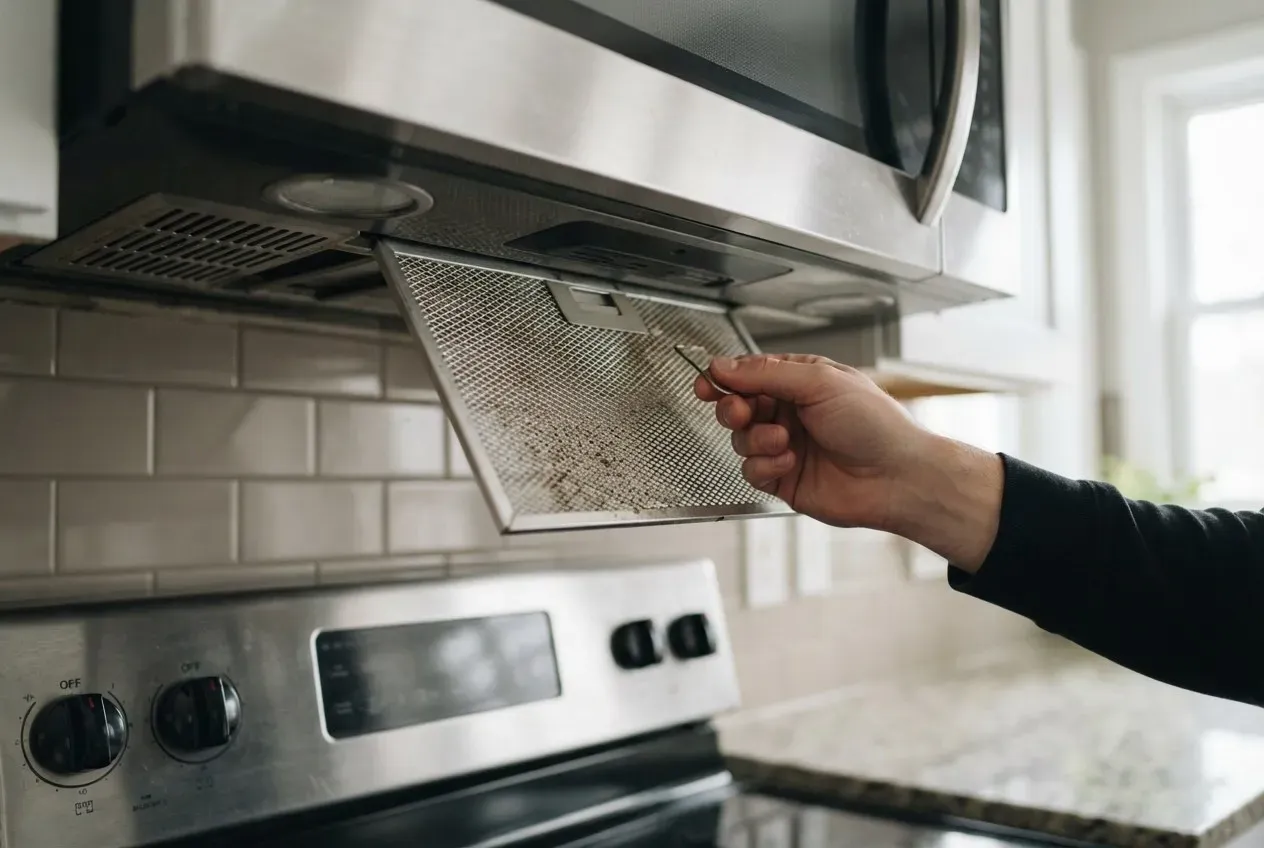
A built-in model, a speed oven or a convection wall microwave is framed by a trim kit in the cabinetry, and a microwave drawer pulls out from a lower cabinet. Getting any of them out is slower work than lifting a countertop microwave, so say which you have when you book.
Vent fan or light out on an over-the-range microwave
The over-the-range microwave is also the range hood. A vent fan that won’t run, runs on one speed only or won’t shut off, and cooktop lights that stay dark, are hood parts on the same unit, and they get looked at on the same visit as any microwave fault.
Glass top, induction board or magnetron: is it worth fixing?
That depends on what a replacement would cost once it’s in place. Swapping out a countertop microwave is cheap. Mounted and built-in units cost more to replace, since the new microwave still needs hanging or fitting, and that often tips the answer toward repair. Cooktops follow the same math with bigger numbers. New glass for a low-priced radiant range can come close to what a new range costs. On an expensive induction cooktop, that same crack is usually still a repair. On older models, parts get harder to find, which can decide it on its own.
Either way, the price comes in writing before the repair goes ahead. Typical kitchen repair prices are in the appliance repair cost guide, and the repair or replace guide goes deeper into age and parts.
Cooktop and microwave repair outside San Jose
Besides San Jose, kitchens in Santa Clara, Cupertino and Milpitas are in the area. Say which city you’re in and how the microwave is mounted, and the visit gets booked with the right amount of time.