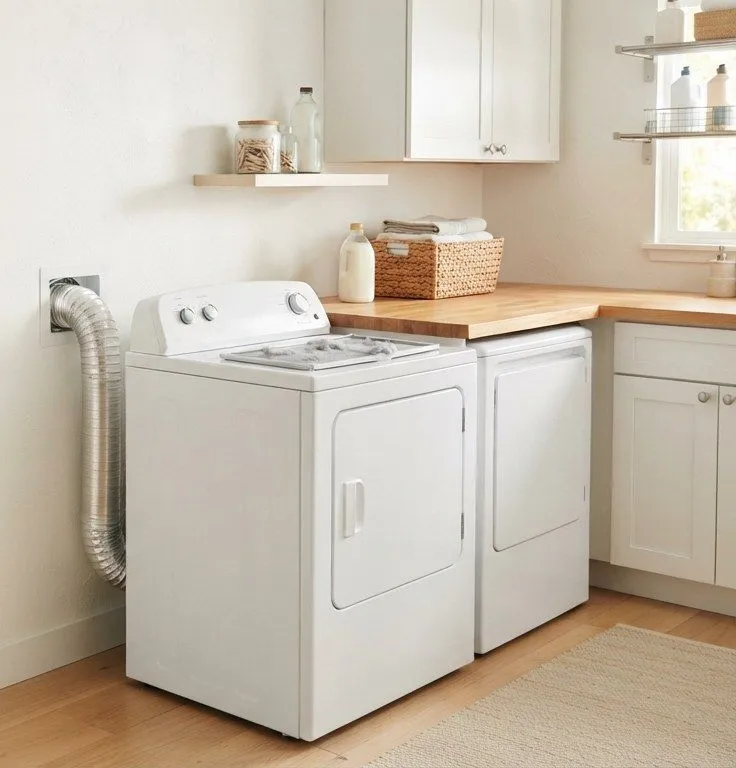
When towels are still damp after the timer runs out, the heater is often working. What’s missing is airflow, because the wet air can’t leave the drum. San Jose Appliance Care books clothes dryer repair in San Jose on electric models wired to a 240-volt circuit, gas models fed by the home’s gas line, and stacked washer and dryer units. A registered, insured tech checks airflow first, then the heat side and the belt, rollers and motor that turn the drum.
Damp towels after a full cycle
The CPSC lists two warning signs of a clogged lint screen or blocked exhaust duct. One is clothes still damp after a regular cycle, and the other is loads that dry slower than they once did. Samsung says much the same thing: a dryer that gets hot but takes too long probably has a plugged vent.
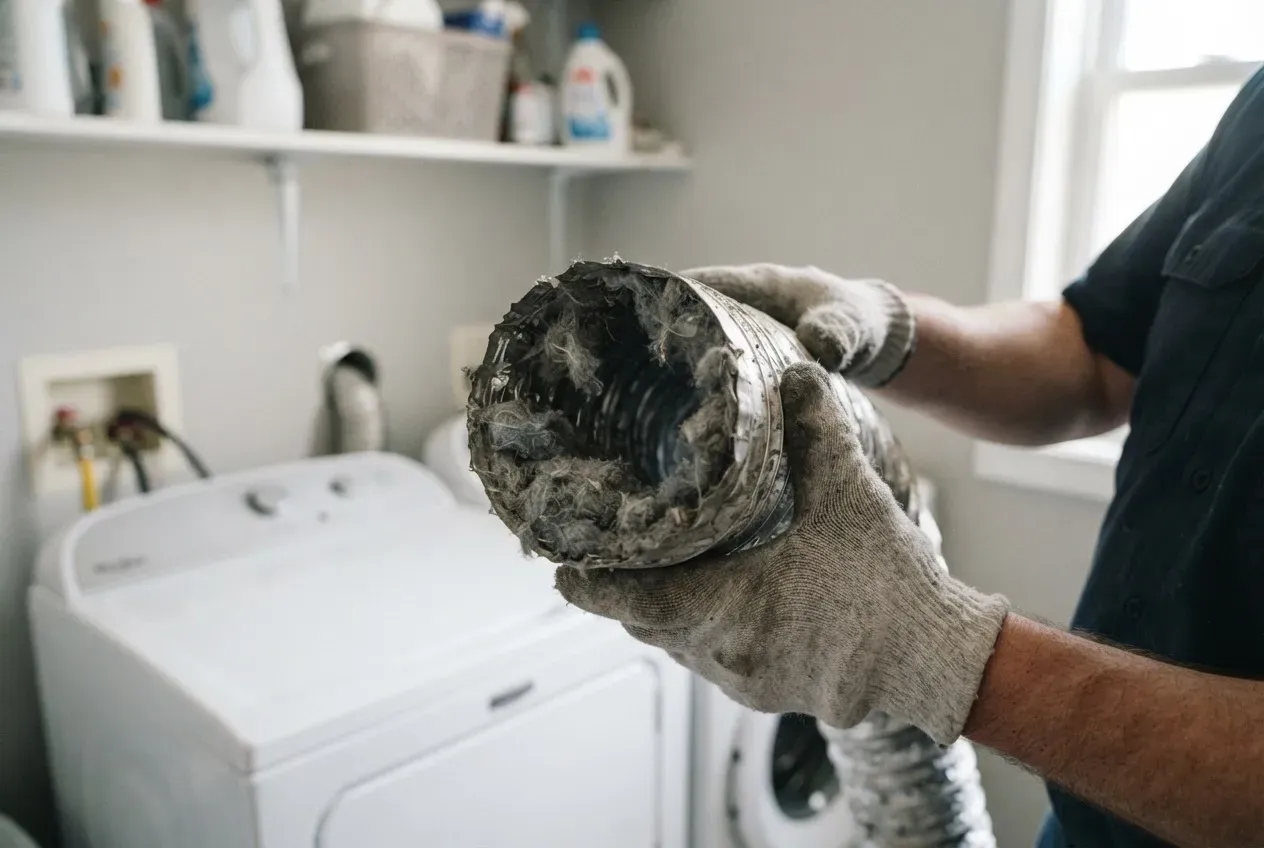
Choked airflow shortens a dryer’s working life as well. CPSC testing showed that lint left in place keeps the drum and the cabinet hotter than they should run, and the extra heat ages the wiring, the connectors and the motor before their time. Fire is the other risk. In the US Fire Administration’s figures for home dryer fires from 2008 to 2010, the top factor was failure to clean, at 34 percent.
On the visit, the tech follows the exhaust all the way out, not only the few feet of duct behind the machine:
- The hood on the outside wall, with the dryer running, to confirm air is coming out and the flap opens all the way
- The short connector duct right behind the dryer, which flattens easily if the machine gets shoved toward the wall
- What the duct is made of, since flexible plastic or foil traps lint and kinks, where the CPSC wants rigid or semi-rigid metal
- The total length of the duct and how many bends it has
- Lint collected inside the dryer cabinet, which the CPSC says a qualified service person should clean out now and then
Vent codes and warning lights
Some dryers spot the blockage for you. An LG showing d90 or d95 has measured the duct as 90 or 95 percent blocked. A Whirlpool lights Check Vent when air can’t flow freely. Read out the code or the light when you call, so the tech knows to begin with the vent.
Long duct runs from an inside laundry closet
The farther the dryer is from an outside wall, the more duct there is to clog. The US Fire Administration has noted that newer homes often put the laundry in an upstairs hall, a bedroom, a bathroom or the kitchen instead of against an exterior wall. From an upstairs closet, the exhaust may travel a long way and turn several corners before it gets outside, and lint drops out at each corner.
Dryer makers set a length limit. LG’s chart allows a 4-inch rigid metal duct to run 65 feet if it’s perfectly straight, and the limit drops with each elbow. Samsung takes six feet off its maximum for each 90-degree bend, and says a dirty or too-long vent holds the moisture in so the cycle drags on. On the call, mention where the dryer stands and where its vent comes out: a side wall, the roof or the eaves.
Drum turns but no heat, gas or electric
The drum spins and the timer runs, but everything comes out cold. Gas or electric is the first fork in the diagnosis.
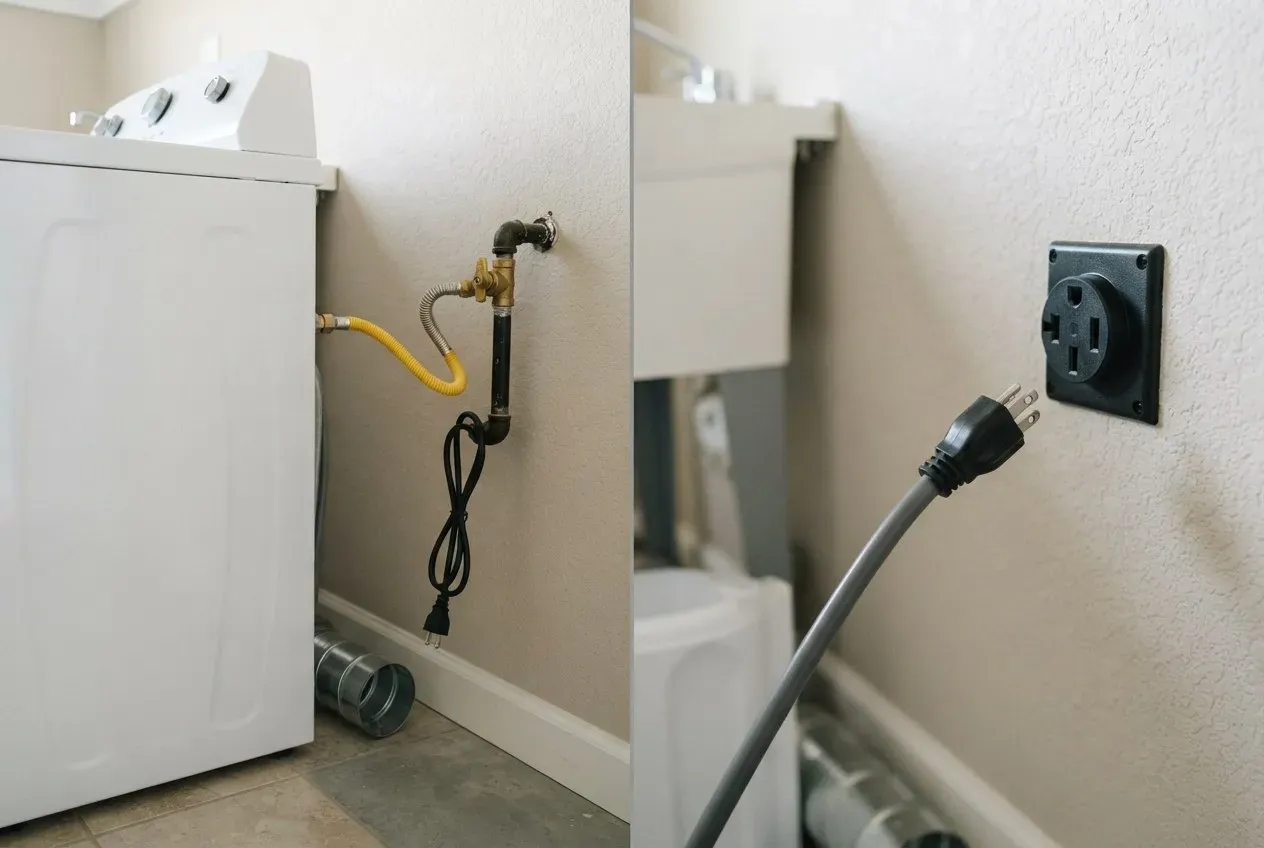
| Electric | Gas | |
|---|---|---|
| Power and fuel | Two breakers feeding a 240-volt, 30-amp circuit (Whirlpool) | A regular outlet, plus a gas line with its own shutoff valve |
| Checked first | Both breakers, because with one tripped the drum turns but nothing heats | The shutoff valve handle, which Whirlpool says belongs parallel to the pipe |
| Usual failed parts | Heating element, thermal fuse, high-limit and cycling thermostats | Igniter, flame sensor, thermal fuse, gas valve coils |
In both its gas and electric guides, Whirlpool reminds owners that air-fluff and air-only settings don’t heat at all. It also says an electric model can’t heat correctly on anything less than a true 240 volts. That can come up after a move or a laundry room remodel.
If a gas dryer clicks and never lights, or the flame catches and dies after a few seconds, the ignition parts are the suspects. The tech puts a meter on the igniter, flame sensor and valve coils before swapping any of them. Smell gas near the dryer? Get everyone out first, then follow the gas safety steps on our oven, range and stove repair page.
Dryer overheating, too hot to touch or shutting off mid-cycle
A cabinet too hot to touch, or a dryer that shuts itself off partway through, almost always means heat isn’t leaving. Lint in the vent and lint packed on the blower wheel both choke the airflow, and the heat builds until a safety part steps in. The thermal fuse is that last step. Whirlpool and Maytag describe it as a one-time cutoff: once it blows, the dryer won’t heat or won’t run, and it can’t be reset, only replaced.
The tech also tests the thermistor, the temperature sensor on the blower housing that tells the control how hot the exhaust is, and the cycling and high-limit thermostats. A sensor that reads wrong lets the heat run too high or cuts it too early. Whatever part failed, the vent gets checked on the same visit, because a new fuse on a choked vent blows again.
Cycle ends early and the clothes are still damp
On automatic cycles the dryer decides when the load is dry by touching it. Two metal strips inside the drum, the moisture sensor bars, read how wet the clothes are. Whirlpool gives the reasons they read wrong. A dryer that isn’t level keeps the clothes from tumbling across the strips. Detergent and fabric softener residue can coat them. Or the sensor itself has failed, and since the sensor and its wiring are behind the panels, that part is the tech’s job.
A timed cycle that dries fine while automatic cycles quit early points at the sensor side rather than the heat side. Mention that on the call.
Burning or hot smell from the dryer
A new dryer can smell for its first few runs, and GE says that fades. A burning smell on a dryer that’s been in use for years isn’t normal. Stop the cycle and unplug it. Lint caught near the heater or burner, a belt slipping on a seized roller and a cord or outlet running hot all give off that smell, and the tech checks each one before the dryer runs again.
Squeal, thump, or a drum that won’t turn
When the belt breaks, the motor keeps running and the drum doesn’t move. A belt that’s wearing out squeals first. Flat spots on the drum rollers make a thump each rotation, and an idler pulley that’s dry will squeak. A rumble from the back or bottom can be the blower wheel, the fan that pushes air out the vent, running loose or caked with lint. After the belt, the motor comes next on the list if it hums without turning the drum or keeps tripping the breaker. Tell us what the noise sounds like and whether it starts right away or once the drum gets up to speed.
If the dryer won’t start at all, the cause may be a door switch that can’t tell the door is shut, a blown thermal fuse or a control lock someone switched on.
Fixing an older dryer or replacing it
Rollers, belts, thermal fuses and igniters make sense to replace on nearly any dryer, even an old one. When an older machine needs a motor or a control board, that’s the time to compare against a new dryer. Keep in mind the vent stays the same. A new dryer on a flattened or too-long duct dries slowly and runs hot too. The vent gets looked at in either case.
The part accounts for most of the cost. A gas dryer has more parts along its heating path, and one stacked on a washer or squeezed into a closet takes more time to get into. Price ranges are in the appliance repair cost guide, and the repair or replace guide compares fixing an old machine with buying new. The price is in writing before the work begins, and you only pay for work you agreed to.
Stacked, ventless and compact dryers
On a stacked laundry center the dryer is mounted on top of the washer, and some repairs need the two pulled apart, so tell us it’s stacked. Heat pump and condenser dryers are ventless, with no duct to the outside, and that includes the compact European machines from Miele and Bosch. The airflow check is different on those, so give the dryer type as well as the brand. If the display shows a code other than a vent warning, the error code library has what the manufacturers say it means.
Dryer repair is also available in Cupertino, Los Gatos and Mountain View, along with Palo Alto, Sunnyvale, Santa Clara, Milpitas and Fremont. If the washer is getting old as well, mention it. Its warning signs are on the washer repair page.