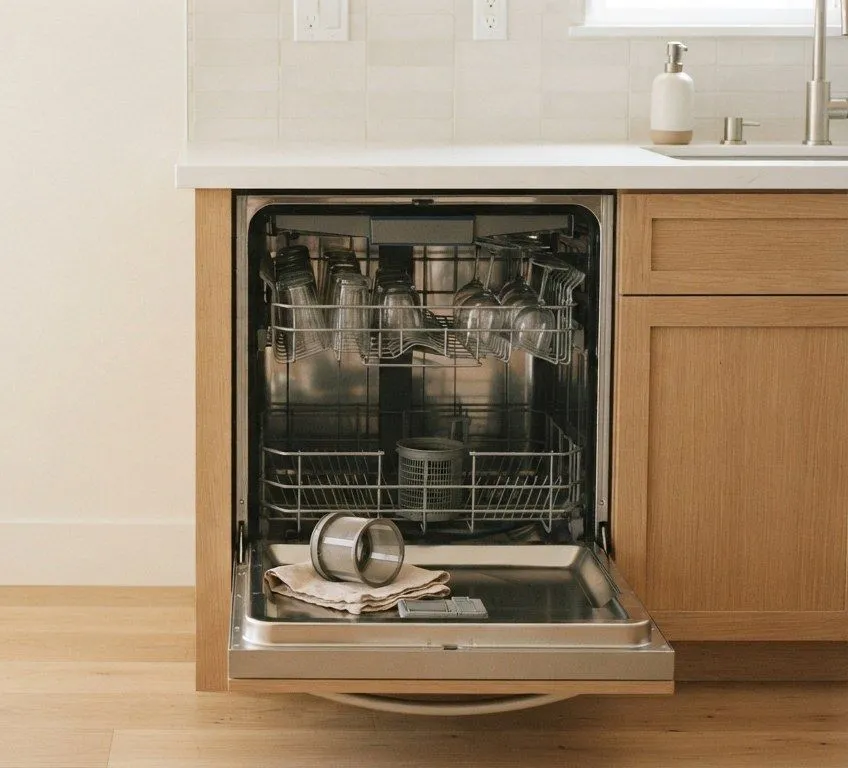
Hard water is the first thing to check on a San Jose dishwasher. San Jose Water’s groundwater is well past the point where water counts as hard, and the minerals end up on glasses, spray arms and heating elements. San Jose Appliance Care takes dishwasher repair calls for standard 24-inch built-ins, panel-ready models and dish drawers. A registered, insured tech checks the spray arms, wash pump, drain pump, door seal and heater, then sorts a water problem from a failed part.
Cloudy film on the glasses after every wash
San Jose Water calls water hard above 7 grains per gallon. Its 2025 report puts groundwater at about 10 to 26 grains, mountain surface water at 5 to 12 and imported surface water at 4 to 9. That spread is why two kitchens a few miles apart can see very different amounts of scale.

GE describes the milky white film as mineral buildup, not etching. It shows up most in hard-water areas and gets worse with detergents made without phosphates. The question on the visit is whether those minerals have started to choke the machine: spray-arm holes plugged with scale, or a crust forming on the heating element.
How fast the film comes back is useful to know. If it’s back within a few days and the spray arms look crusted, say so when you call. That points the tech at the arms, the filter and the heater before anything else.
Dishes not getting clean, or food left on the dishes
Grit and food left behind is a different problem from cloudy film. It usually means water isn’t reaching the dishes with enough force. A clogged filter, spray arms with plugged holes, a spray arm that won’t spin or a weak wash pump all do it. Hard water adds to it by crusting over the spray-arm holes. Whirlpool also notes that overloaded racks block the arms, so try one lightly loaded cycle before calling.
Water left over the filter when the cycle ends
Whirlpool’s list for a dishwasher that won’t drain runs from common to rare. First comes a clogged filter, then food packed into the sump and a kinked or sagging drain hose. After those: a blocked air gap or disposal connection, a jammed drain pump or impeller, and once in a while a drain solenoid, timer or control board.
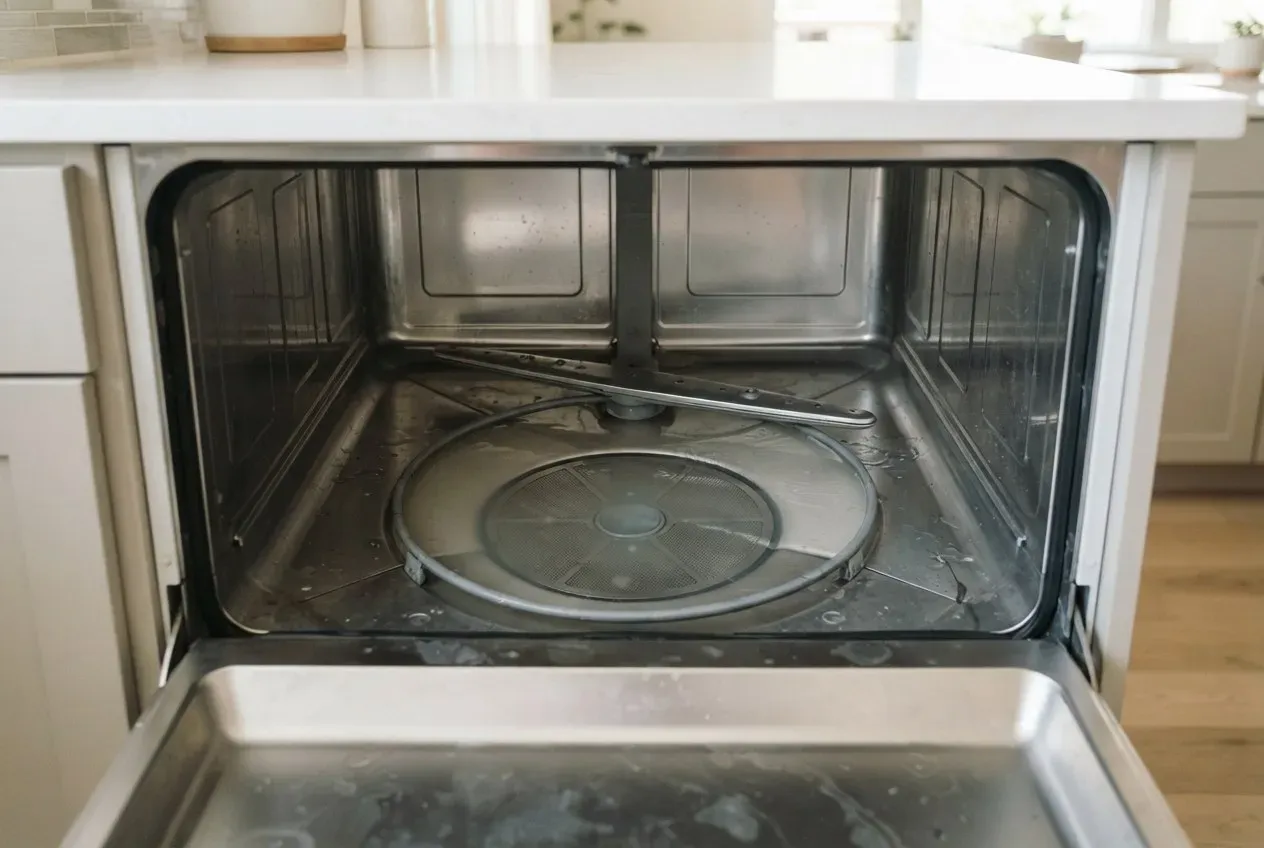
The drain hose needs a high loop or an air gap under the sink so dirty water can’t run back into the tub. KitchenAid points out that most built-ins drain through the garbage disposal, which makes the disposal part of the drain path. If the disposal hums or won’t clear either, our garbage disposal repair page covers that side of the sink.
Dishwasher won’t fill with water
Check the easy two first: the door has to latch before the fill starts, and the valve under the sink has to be open. Past those, Whirlpool lists a blocked or failed inlet valve, an overfill float stuck in the up position and a drain hose with no high loop siphoning water out as fast as it comes in. A quiet machine that hums briefly and then stops, with a dry tub, is the classic sign. Leave the float alone and let the tech test the valve and the float switch.
Loud grinding or humming
A grinding noise during the wash usually means something hard got into the pump: a piece of glass, a bone, an olive pit or a broken spray-arm tip. A steady hum with no water moving points at a drain or wash pump that’s jammed or failing. Stop the cycle so a jam doesn’t chew up the impeller, and tell us which part of the cycle the noise comes in.
A bad smell from the dishwasher
A sour smell almost always starts with food trapped where water doesn’t reach: the filter, the sump under it, the door gasket or the drain hose. A drain path that lets dirty water sit or flow back from the sink makes it worse. If cleaning the filter doesn’t clear it, the drain hose loop, the air gap and a partial clog get checked on the visit.
A puddle at the toe kick
Suds cause more leaks than people expect. GE says the wrong detergent, or too much of it, foams enough to push water past the door seal and onto the floor. Hand dish soap left on rinsed plates does the same, and so does rinse aid spilled on the door. Only automatic-dishwasher detergent belongs in the machine.
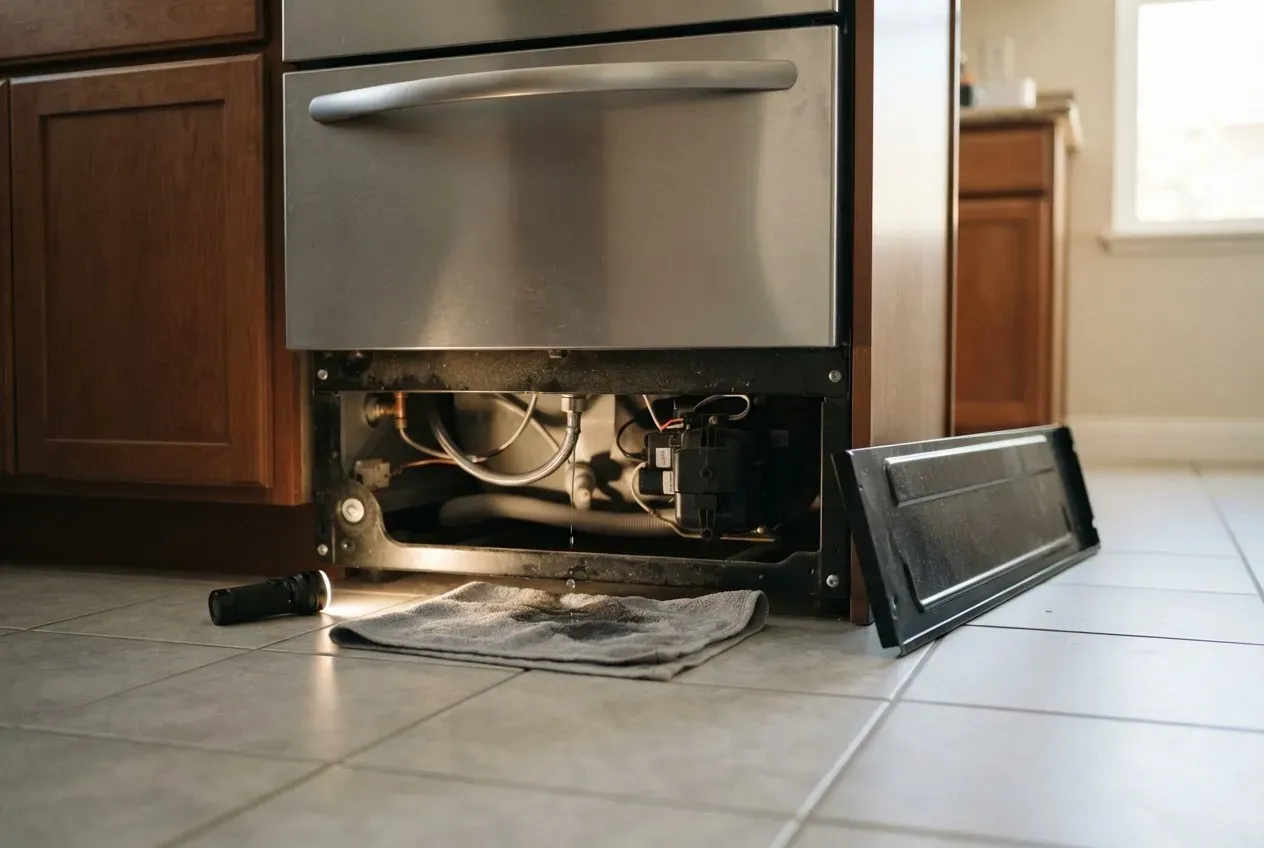
With suds ruled out, the tech looks at the door gasket for tears or trapped food, then under the tub at the supply line, the drain connection and the pump seal. A slow leak under a built-in runs into the cabinet base, and nobody sees it until the floor or the cabinet shows damage.
Bosch and Thermador dishwashers catch that water themselves. E15 on the display means a safety switch has found water in the base pan, and the leak protection system has stopped the cycle. Every Bosch dishwasher also has AquaStop, which shuts the water off at the supply connection when it senses a leak. The code stays until the base is dry and the source is fixed, so don’t tip the unit to drain it. The Bosch repair page and the appliance error code library cover the other Bosch codes.
While you wait for the visit:
- Close the dishwasher’s water valve under the sink.
- Switch off its breaker if water has reached the cabinet or the floor.
- Lay towels along the toe kick.
Dishes still wet at the end of the cycle
Drying works differently from brand to brand, so the same wet rack can mean different things. On models that dry with a heating element or a fan and vent, wet dishes after a heated-dry cycle point at the element, the fan, the vent or an empty rinse-aid dispenser.
Bosch’s CrystalDry models use a mineral that turns moisture into heat, up to 176°F, and Bosch rates them well ahead of its PureDry models. Damp plastics in a Bosch without CrystalDry can be normal. Rinse aid helps on every type, since it lets water sheet off instead of beading. With the brand and model, the tech can tell a normal result from a failed part.
Door won’t latch, won’t start, or stops halfway with a code
A door latch that doesn’t register the door as shut, a control lock left on or a failed control board will each keep a dishwasher from starting. A door that won’t catch at all usually has a broken latch or strike, or a rack or utensil holding it open. A door that closes but the dishwasher beeps and won’t run has a latch switch that isn’t reading. A cycle that quits partway, usually with a code on the display, is often a heating, drain or water-supply fault the control has caught.
Write the code down before it clears. The appliance error code library lists what each maker’s codes mean, and reading it out on the call saves time on the visit.
Panel-ready and built-in models take longer to pull
A panel-ready dishwasher wears a cabinet panel screwed to its door, with toe kick and side trim fitted to the kitchen. Pulling one out takes more care than a standard unit. Mention that it’s built in, and the visit gets booked with the time it needs. Name the brand, and say if it might still be under warranty. Owners of a Bosch dishwasher or a Thermador will find each maker’s warranty terms on its own page.
Replacing a panel-ready unit means matching the opening and refitting the panel, which usually tips the decision toward repair. A builder-grade dishwasher with a failed pump or control board is a closer call. The repair or replace guide works through it.
What sets the price of a dishwasher repair
The part sets most of it. A door gasket or a drain hose is a small job. A wash or drain pump costs more, and a control board or motor costs the most. Panel-ready access and a part that has to be ordered add to it as well. The appliance repair cost guide puts typical ranges side by side.
You see the written price before the work starts, and you only pay for work you agreed to.
Dishwasher repair outside San Jose
Hardness changes from one city to the next. Sunnyvale’s north and south sides get different water, which the Sunnyvale appliance repair page explains. The same service covers Palo Alto, Milpitas, Santa Clara, Mountain View, Cupertino, Los Gatos and Fremont. Tell us which city you’re in, since it tells the tech what water the machine has been running on.